Effective Date: 30 June, 2025
GraniteShares, Inc. and its affiliates (“GraniteShares,” “we,” “us,” or “our”) recognize the importance of protecting your privacy and personal information. This Privacy Policy explains how we collect, use, share, and safeguard your personal information when you visit our website located at https://graniteshares.com (the “Website”) and when you otherwise interact with us online or offline. By accessing or using the Website, you acknowledge that you have read and understood this Privacy Policy and agree to the collection and use of your information as described herein.
We are committed to respecting your privacy and to complying with all applicable privacy laws, including the California Consumer Privacy Act (“CCPA”), where applicable. This Privacy Policy is designed to inform you about our practices regarding the collection, use, and sharing of personal information that may be provided by you or collected through your interactions with our Website, products, services, and communications.
Information We Collect
We may collect personal information directly from you, automatically through your use of our Website, or from third-party sources. The types of information we collect may include your name, email address, mailing address, telephone number, employment or professional information, IP address, browser type, device identifiers, geolocation data, and any other information you voluntarily provide through forms, inquiries, or communications with us.
Information is collected when you subscribe to our mailing list, download materials, request information, or otherwise choose to engage with us. We may also collect certain information automatically through the use of cookies, web beacons, and other tracking technologies that allow us to understand how you interact with our Website, including pages visited, time spent, links clicked, and referral sources.
Use of Information
We use the information we collect to respond to your inquiries and requests, provide you with access to our products and services, send you marketing or promotional materials (where permitted by law), communicate with you about your account or transactions, improve the Website and our offerings, comply with legal and regulatory requirements, and prevent fraudulent or unauthorized activities.
We may also use aggregated or anonymized data for statistical, analytical, or research purposes to help us better understand trends and user behavior. This information does not personally identify you and is not considered personal information under applicable law.
No Sale of Personal Information
GraniteShares does not sell your personal information, as defined by the CCPA. This policy applies to all users.
Sharing of Information
We do not sell, rent, or trade your personal information. We may share your information with trusted third-party service providers who assist us in operating our Website, conducting our business, or servicing you, provided that such third parties agree to maintain the confidentiality and security of your personal information.
We may also share personal information as required by law, such as to comply with a subpoena, legal process, or government request; when we believe in good faith that disclosure is necessary to protect our rights, investigate fraud, or respond to a regulatory inquiry; or in the event of a merger, acquisition, or reorganization involving GraniteShares.
Data Security
We maintain reasonable physical, technical, and administrative safeguards to protect personal information from loss, misuse, unauthorized access, disclosure, alteration, or destruction. However, no method of transmission over the Internet or electronic storage is completely secure. Therefore, we cannot guarantee the absolute security of your information.
You are responsible for maintaining the confidentiality of any login credentials or account information used to access any part of the Website. We recommend that you take appropriate precautions to secure your devices and use strong passwords.
Cookies and Tracking Technologies
We use cookies and similar technologies to enhance your browsing experience, analyze usage patterns, and deliver personalized content. Cookies are small text files placed on your computer or device that allow us to recognize you and remember your preferences when you return to the Website.
You can adjust your browser settings to refuse or delete cookies, but doing so may limit your ability to use certain features of the Website. For more information about our use of cookies, please refer to our Cookie Policy.
Third-Party Websites
Our Website may contain links to websites operated by third parties that are not affiliated with GraniteShares. We are not responsible for the privacy practices or the content of such third-party websites. We encourage you to review the privacy policies of those websites before providing them with any personal information.
Sharing of Information
Your personal information may be shared with trusted third-party service providers who assist us in operating our business, handling customer service, and performing related functions. We require these service providers to protect your information under confidentiality agreements. We may also disclose information if required by law, subpoena, or regulation, or to protect our rights and investigate fraud. Additionally, your information may be shared as part of mergers, acquisitions, or reorganizations involving GraniteShares.
Children’s Privacy
Our Website is not intended for use by individuals under the age of 18. We do not knowingly collect personal information from children. If we become aware that personal information from a child has been collected without verifiable parental consent, we will take appropriate steps to delete such information as soon as possible.
Your California Privacy Rights
If you are a California resident, you have certain rights under the California Consumer Privacy Act (CCPA), including the right to request information about the categories and specific pieces of personal information we have collected about you, the right to request deletion of your personal information, and the right to opt out of the sale of your personal information. GraniteShares does not sell personal information as defined under the CCPA.
To submit a CCPA request, please contact us at compliance@graniteshares.com or write to us at the address provided below. We may need to verify your identity before processing your request.
Do Not Track Signals
Some web browsers may transmit “Do Not Track” signals to websites. Our Website does not respond to such signals at this time, as there is no uniform industry standard for compliance.
International Use
GraniteShares operates in the United States and other jurisdictions. If you access the Website from outside the United States, please note that your information may be transferred to, stored, and processed in the United States or other jurisdictions where privacy laws may not provide the same level of protection as those in your home country. By using the Website, you consent to the transfer of your information to countries outside your jurisdiction, including the United States.
Changes to This Privacy Policy
We may update this Privacy Policy from time to time to reflect changes in our practices, technologies, or legal obligations. If we make any material changes, we will notify you by posting the updated policy on the Website and updating the “Effective Date” above. Your continued use of the Website after such changes constitutes your acceptance of the revised Privacy Policy.
Your Rights and Choices
Individuals whose personal information we collect may have certain rights under applicable data protection laws. Subject to legal and regulatory requirements and limitations, you may have the right to request access to the personal information we maintain about you, to correct inaccuracies, or to request deletion of your information. You may also have the right to request that we restrict or limit how we process your data, and in some cases, to object to the processing altogether. Where applicable, you may request to receive your personal data in a structured, commonly used, and machine-readable format so that you can transfer it to another service provider (a right known as data portability).
In situations where we rely on your consent to collect, use, or disclose your personal information—such as in connection with email marketing communications or where sensitive personal data is involved—you have the right to withdraw that consent at any time. Withdrawal of consent will not affect the lawfulness of processing that occurred prior to the withdrawal. To exercise any of your data-related rights, please contact us at info@graniteshares.com. We may need to verify your identity before processing certain requests.
We retain your personal information only as long as is reasonably necessary to fulfill the purposes for which it was collected, including to provide our services, comply with our legal obligations, resolve disputes, and enforce our agreements. The specific retention period for your data may vary depending on the type of data and the applicable legal requirements in the jurisdictions where we operate.
Contact Us
If you have any questions or concerns about this Privacy Policy or our data practices, you may contact us at:
GraniteShares, Inc.
250 Broadway, 24th Floor,
New York, NY, 10007, USA
Email: info@graniteshares.com
International Users and Data Subject Rights
If you are located in the European Economic Area (EEA), the United Kingdom, or another jurisdiction that provides specific rights under applicable data protection laws, you may be entitled to certain rights regarding your personal information. These rights may include the right to access the personal information we hold about you, the right to correct or update inaccurate or incomplete data, and the right to request deletion of your personal data under certain circumstances. You may also have the right to restrict how we process your information, the right to receive a copy of your data in a structured, commonly used, and machine-readable format (data portability), and the right to object to the processing of your personal data based on our legitimate interests or for direct marketing purposes.
Where we rely on your consent to process your personal data, you may withdraw that consent at any time, without affecting the lawfulness of any processing based on consent before its withdrawal. These rights are subject to certain limitations and conditions as provided by applicable law.
To exercise any of these rights or if you have questions about how your personal data is processed, you may contact us at info@graniteshares.com. Depending on your location, you may also have the right to lodge a complaint with a supervisory authority in your jurisdiction. For individuals in the EEA, a list of supervisory authorities is available at https://edpb.europa.eu/about-edpb/board/members_en.
Effective Date: July 1, 2020
This Cookie Policy explains how GraniteShares Inc. (“GraniteShares”, “we”, “us”, or “our”) uses cookies and similar technologies on our website located at https://graniteshares.com (“Website”). Cookies are small text files placed on your device that allow us to recognize your browser or device and remember certain information, such as user preferences or login details. This policy explains what types of cookies we use, the purposes for which we use them, and how you can manage or disable them. This Cookie Policy should be read in conjunction with our Privacy Policy, which provides further information on how we process personal data collected via cookies and other means.
When you visit our Website, we may automatically collect certain information from your device through the use of cookies and similar tracking technologies. These technologies may be set by GraniteShares or by third-party service providers acting on our behalf, including analytics and advertising partners. The cookies used on our Website include those that are strictly necessary to enable core site functionality, performance cookies to analyze how users interact with the Website, functional cookies to remember user choices and preferences, and targeting cookies that support advertising relevant to your interests. These cookies may remain on your device for the duration of your browsing session or may persist for a longer period to enable us to recognize you when you return.
The content on this Website has been prepared for informational purposes only and without regard to the investment objectives, financial situation, or particular needs of any specific person or entity. The material does not constitute investment advice, an offer to sell, or a solicitation of an offer to buy any securities or investment products in any jurisdiction where such an offer or solicitation would be unlawful.
Nothing on this Website shall be construed as a recommendation to invest in any financial instrument. Products and services described on the Website may not be suitable for all investors and may not be available in all jurisdictions.
Access to this Website is provided in jurisdictions in which GraniteShares operates, including the United States, the United Kingdom, Italy, Germany, France, and various Asian markets such as Hong Kong, South Korea, Japan, and India. In certain other jurisdictions, access may be facilitated through authorized brokers or distribution partners. This Website is not intended for any person located in a jurisdiction where the availability of the Website or its contents would be contrary to local law or regulation. Users are responsible for ensuring that accessing the Website is permissible under the laws applicable in their respective jurisdictions.
The information and content available on this Website are provided on an “as is” and “as available” basis without warranties of any kind, either express or implied. GraniteShares makes no representations or warranties regarding the accuracy, completeness, availability, timeliness, or reliability of the content or the operation of the Website. To the fullest extent permitted under applicable law, GraniteShares disclaims all warranties, including any implied warranties of merchantability, fitness for a particular purpose, and non-infringement. We do not guarantee that the Website or any content will be free of errors, viruses, or harmful components, or that access to the Website will be uninterrupted.
To the extent permitted by applicable law, GraniteShares shall have no liability for any direct, indirect, incidental, consequential, or punitive damages arising out of or in connection with your use or inability to use the Website or reliance on any content contained herein. This includes, without limitation, any loss of profit, loss of business, or loss of data, whether arising in contract, tort (including negligence), or otherwise, even if such damages were foreseeable or we were advised of the possibility thereof. In jurisdictions that do not allow the exclusion or limitation of liability, GraniteShares’ liability shall be limited to the maximum extent permitted by law.
All intellectual property rights in the Website and its content, including but not limited to copyrights, trademarks, service marks, trade names, and proprietary technology, are owned by GraniteShares or licensed to us by third parties. The content of the Website is protected by applicable intellectual property laws and may not be copied, distributed, modified, or used in any way without our prior written permission, except as permitted under applicable law. Users may access and use the Website for personal, non-commercial use only. Any unauthorized use, including the framing, reproduction, or systematic extraction of Website content, is strictly prohibited.
Investing involves risk, and the value of investments and the income from them may fall as well as rise. Past performance is not a reliable indicator of future performance. You may not get back the amount originally invested. Investment outcomes may also be affected by fluctuations in currency exchange rates. Products and strategies discussed on this Website may not be suitable for all investors and may not be available in all jurisdictions. The contents of this Website do not constitute investment advice, an offer to sell, or a solicitation to buy any securities.
Personal information collected through cookies and other means is processed in accordance with our Privacy Policy. The Privacy Policy provides further information about the types of data we collect, the purposes for which we use it, and your rights in relation to your data. By using this Website and consenting to the use of cookies, you acknowledge and accept our data practices as described in the Privacy Policy. You are required to review and agree to our Privacy Policy before accessing the Website. Upon your confirmation of acceptance, we may place a cookie on your browser to remember your preferences and to avoid repeating the disclosure notice on future visits. This cookie may expire after six months or earlier if there is a material change to the policy.
If you have any questions, comments, or concerns about this Cookie Policy, or if you wish to update your personal information or cookie preferences, please contact us using the details below:
GraniteShares Inc
c/o GraniteShares Inc
250 Broadway – 24th Floor
New York, NY 10007
By phone: 844-476-8747
By email: info@graniteshares.com
If you are a registered user and need to update your account information, you may do so by logging into your account. Alternatively, you may contact us by email or telephone to ensure your information remains accurate and up to date.
While GraniteShares does not currently meet the threshold for mandatory compliance under the California Consumer Privacy Act (CCPA), we acknowledge the privacy rights of California residents. For more information about our collection and use of personal information, including any applicable rights under California law, please refer to our Privacy Policy available at: https://graniteshares.com/institutional/us/en-us/privacy-policy.
Graniteshares Terms and Conditions of Use
Last Updated: 30 June, 2025
READ THESE TERMS AND CONDITIONS (“TERMS”) CAREFULLY BEFORE USING THIS WEBSITE. BY ACCESSING OR USING THE WEBSITE LOCATED AT WWW.GRANITESHARES.COM (“WEBSITE”), YOU ACKNOWLEDGE THAT YOU HAVE READ, UNDERSTOOD, AND AGREED TO BE BOUND BY THESE TERMS. IF YOU DO NOT AGREE TO THESE TERMS, DO NOT ACCESS OR USE THIS WEBSITE.
Defined Terms
Welcome to the website operated by GraniteShares, Inc. and its affiliates (“GraniteShares”, “we”, “us”, or “our”). By accessing or using our website (the “Website”), you agree to be bound by these Terms and Conditions of Use (“Terms”), along with our Privacy Policy and any other applicable legal notices.
Please read these Terms carefully before using the Website. If you do not agree with these Terms, you must not use the Website.
General Use
This Website is provided for informational purposes only and is not intended to offer investment, legal, tax, or accounting advice. The Website content is subject to change without notice and may not always be current. Access and use of the Website are at your own risk.
Website Operation and Access
GraniteShares controls and operates this Website from the United States. We make no representations that the Website or its content is appropriate or available for use in all locations. Access from jurisdictions where the content is illegal is prohibited.
Website Content and Timeliness
The information presented on the Website is believed to be accurate as of the date it is posted. However, GraniteShares makes no representations or warranties regarding the timeliness, accuracy, or completeness of any information. We assume no duty to update the information provided.
Fund Disclosures
Before investing in any GraniteShares product, you should carefully review the fund’s prospectus, which contains important information about investment objectives, risks, charges, and expenses. Prospectuses are available at https://www.graniteshares.com. Read them carefully before investing.
SEC Materials
Some documents and disclosures available on this Website have been filed with the U.S. Securities and Exchange Commission (“SEC”) and are publicly accessible. While GraniteShares strives to ensure the accuracy and timeliness of these materials, the official versions of all filings are those available through the SEC’s EDGAR database. We do not guarantee the completeness or currency of any materials linked on the Website.
Disclaimer of Investment Advice
Nothing on this Website constitutes an offer to sell or a solicitation of an offer to buy any securities. No content constitutes a recommendation to buy, sell, or hold any security or investment product. The use of leverage or short investment strategies involves unique risks and may not be appropriate for all investors.
Social Media Disclosures
Content shared by GraniteShares on its social media accounts is for informational purposes only and does not constitute an offer, solicitation, or investment advice. Any third-party content shared or retweeted does not represent the views of GraniteShares.
Governing Law and Jurisdiction
These Terms are governed by and construed in accordance with the laws of the State of Delaware, United States, without regard to its conflict of law provisions. You agree to submit to the exclusive jurisdiction of the state and federal courts located in Delaware for the resolution of any disputes arising from or related to these Terms or your use of the Website.
Privacy Policy
Your use of the Website is subject to our Privacy Policy, which governs how we collect, use, and store your personal data. By using the Website, you consent to the data practices described in the Privacy Policy.
Cookies and Connection Requirements
GraniteShares may use cookies to improve Website functionality and user experience. Your device and browser must meet minimum technical requirements to access the Website. You are responsible for ensuring your own internet connectivity and system compatibility.
Email and Marketing Communications
If you subscribe to receive communications from GraniteShares, you agree to receive emails and/or SMS alerts about products, updates, or marketing materials. Message and data rates may apply. You may unsubscribe at any time by following the provided instructions.
No Warranty; Limitation of Liability
The Website and its Content are provided on an “as is” and “as available” basis without any warranties of any kind. GraniteShares makes no representations or warranties, express or implied, regarding the accuracy, reliability, completeness, or availability of the Website or its Content.
To the fullest extent permitted by law, GraniteShares disclaims all liability for any direct, indirect, incidental, special, or consequential damages, including but not limited to loss of profits, trading losses, data loss, or business interruption, arising out of or in connection with your access to or use of the Website.
Password Security and Notification
If you are provided with a username and password for access to restricted areas of the Website, you are responsible for maintaining their confidentiality. You must notify GraniteShares immediately if you become aware of any unauthorized use of your login credentials.
Prohibited Uses
You agree not to:
• Use the Website for unlawful, abusive, or fraudulent purposes;
• Interfere with or disrupt the Website or any server or network;
• Attempt unauthorized access to GraniteShares systems or data;
• Engage in data scraping or harvesting.
Permitted Use and User Conduct
You agree to use the GraniteShares Website solely for lawful purposes and in accordance with these Terms and Conditions. Your access to and use of the Website must comply with all applicable local, state, national, and international laws and regulations.
You must not engage in any activity that could damage, disable, overburden, or impair the Website, or interfere with any other person’s use of the Website. This includes attempting to gain unauthorized access to any part of the Website, server, or network connected to the Website, whether through hacking, password mining, or any other unauthorized means.
The use of automated tools or systems to collect data from the Website is strictly prohibited. This includes spiders, bots, web crawlers, screen scrapers, or any other similar technologies or processes used to gather information without express written permission from GraniteShares.
You must not introduce or transmit any viruses, malware, or other harmful code that could disrupt or compromise the Website’s security, functionality, or the data of its users.
Using the Website for any commercial purpose is not permitted unless you have received prior written consent from GraniteShares. This includes using the Website to advertise, market, or resell information or services.
GraniteShares reserves the right to suspend, restrict, or terminate your access to the Website at any time, with or without notice, if you violate these Terms or engage in any conduct that is harmful to the Website, the Company, or other users.
Third-Party Content and Links
The Website may contain links to third-party websites or display content provided by third parties. GraniteShares does not control, endorse, or assume responsibility for any third-party content or websites. Your access and use of such websites are subject to the third parties’ terms and conditions, and you do so at your own risk.
Links to Other Websites
Links to external websites are provided for your convenience only. GraniteShares does not control or endorse the content of these websites and assumes no responsibility for their practices, policies, or accuracy.
Linking to GraniteShares
No third-party website may link to GraniteShares’ Website without our prior written approval. You may not frame or mirror any part of the Website or suggest endorsement by GraniteShares without consent.
Transmissions to and From the Website
Any communication or material you send to the Website is transmitted on a non-confidential basis and becomes the property of GraniteShares. We may use such communications for any lawful purpose without compensation to you.
Transmissions of Data and Security Risks
Internet communications may not be secure. GraniteShares is not responsible for any loss or damage resulting from unauthorized interception, virus transmission, or delay in data delivery while using the Website.
System Outages and Incomplete Transmissions
GraniteShares is not responsible for Website unavailability, outages, data corruption, or incomplete transmissions due to internet failure, system errors, or software malfunctions. We reserve the right to suspend Website access at any time.
Limitation of Lqiability
To the maximum extent permitted by law, GraniteShares is not liable for any direct, indirect, incidental, consequential, or punitive damages arising from your use or inability to use the Website, or any linked third-party site.
Indemnification
You agree to indemnify, defend, and hold harmless GraniteShares and its affiliates from any claims, liabilities, damages, or expenses (including attorneys’ fees) arising out of your use of the Website or violation of these Terms.
Jurisdiction and Governing Law
These Terms shall be governed by the laws of the State of New York. You consent to the exclusive jurisdiction of the courts located in New York, NY, for the resolution of any legal matters arising under or related to these Terms.
Waiver
No waiver by GraniteShares of any breach of these Terms shall be deemed a waiver of any prior or subsequent breach. All rights and remedies under these Terms are cumulative and do not exclude other rights or remedies provided by law.
Integration and Severability
These Terms constitute the entire agreement between you and GraniteShares regarding use of the Website. If any provision is held to be invalid or unenforceable, the remainder of the Terms will remain in full force and effect.
Termination
GraniteShares may terminate or restrict your access to the Website at any time, for any reason, without prior notice. Provisions of these Terms that by their nature should survive termination shall survive.
Limitations as to Sections 13, 14 and 15
Some jurisdictions do not allow the exclusion or limitation of certain liabilities, so the limitations in Sections 13 (Unauthorized Use of Content), 14 (System Outages), and 15 (Termination) may not apply to all users.
Copyright, Trademark, and License
All rights to content, marks, and materials appearing on the Website are owned by GraniteShares or their respective licensors. Use of such intellectual property is strictly prohibited without prior written authorization.
Copyright Agent
GraniteShares respects the intellectual property rights of others and expects users of its Website to do the same. If you believe that any content on this Website infringes your copyright, you may submit a written notification in accordance with the Digital Millennium Copyright Act (DMCA), providing the following information:
1. A physical or electronic signature of the person authorized to act on behalf of the copyright owner;
2. A description of the copyrighted work that you claim has been infringed;
3. A description of where the allegedly infringing content is located on the Website;
4. Your contact information (including address, telephone number, and email);
5. A statement that you have a good faith belief that the disputed use is not authorized by the copyright owner, its agent, or the law;
6. A statement, made under penalty of perjury, that the above information is accurate and that you are the copyright owner or authorized to act on their behalf.
Please send your DMCA notice to:
Copyright Agent
GraniteShares, Inc.
[Insert Business Address]
Email: compliance@graniteshares.com (or another suitable contact email)
Subject: DMCA Takedown Request
Please note that misrepresenting material facts in your notice may result in liability under Section 512(f) of the DMCA.
Fund Disclosures
Investors should consider investment objectives, risks, charges, and expenses of any GraniteShares fund before investing. This and other important information is included in the fund’s prospectus. Please read it carefully before investing. Prospectuses are available at https://www.graniteshares.com.
Terms Updates
GraniteShares reserves the right to modify these Terms at any time. Changes will be effective immediately upon posting. Continued use of the Website constitutes your acceptance of any revised Terms.
Modifications to the Website and Terms
GraniteShares may modify, suspend, or discontinue the Website or its Content at any time without prior notice. We may also revise these Terms from time to time. All changes will be effective when posted on the Website. By continuing to use the Website after such changes are posted, you agree to be bound by the revised Terms.
Entire Agreement
These Terms, together with our Privacy Policy and Cookie Policy, constitute the entire agreement between you and GraniteShares regarding your use of the Website. They supersede all prior agreements, understandings, or representations, whether written or oral.
Severability and Waiver
If any provision of these Terms is found to be invalid or unenforceable, that provision will be severed, and the remainder will remain in full force and effect. No waiver of any term or right under these Terms shall be deemed a continuing waiver of such term or any other term.
Contact Information
Please contact us here if you have any questions or concerns about these Terms.
12-Month Trailing Yield:
The yield an investor would have received if they held the fund over the last 12 months, based on the most recent net asset value (NAV). It is calculated by summing income, capital gains, and return of capital distributions paid over the past 12 months, and dividing that by the most recent NAV plus any capital distributions made over the same period.
Bid/Ask Spread:
The difference between the highest price a buyer is willing to pay (bid) and the lowest price a seller is willing to accept (ask). It is an indicator of liquidity and trading costs.
Business Development Companies (BDCs):
Publicly traded investment firms that provide capital to small and mid-sized businesses, often in the form of debt or equity. BDCs are required to distribute most of their income to shareholders to qualify for favorable tax treatment.
Closed-End Funds (CEFs):
Pooled investment vehicles that raise a fixed amount of capital through an IPO and then list their shares for trading on an exchange. Unlike open-end funds, CEFs do not issue or redeem shares daily.
Daily Reset:
A feature of leveraged and inverse ETFs where the fund seeks to deliver a specific multiple of the underlying asset’s daily performance. Because of this daily reset, returns over longer periods may deviate significantly from the expected multiple of the benchmark performance.
Derivatives:
Financial contracts whose value is based on the performance of an underlying asset, index, or rate. Common derivatives include options, futures, and swaps. Derivatives are often used to gain leverage or hedge risk.
ETF (Exchange-Traded Fund):
A pooled investment vehicle that holds a basket of assets (stocks, bonds, etc.) and trades on a stock exchange like a single security. ETFs offer intraday liquidity and typically track an index or strategy.
Gold Benchmark – LBMA Gold Price PM:
A globally recognized benchmark for gold pricing administered by ICE Benchmark Administration (IBA). It is based on the afternoon (PM) auction for the London Bullion Market.
Intended Audience:
Refers to the investor type or classification for whom a financial product or content is designed such as retail investors, professional clients, or qualified investors.
Long Position:
An investment strategy that seeks to profit from a rise in the price of a security. In leveraged ETFs, a “long” fund might offer 2x or 3x the daily performance of the underlying asset.
Margin Call:
A request from a broker for an investor to deposit additional funds or securities into a margin account to cover potential losses.
Market Maker:
A firm or dealer that provides liquidity by continuously offering to buy and sell securities at publicly quoted prices. Market makers help reduce spreads and facilitate trading.
Market Price:
The current trading price at which a security or ETF share is bought or sold on an exchange.
Master Limited Partnerships (MLPs):
Publicly traded partnerships that primarily operate in energy and natural resources. MLPs combine the tax benefits of partnerships with the liquidity of publicly traded securities.
NAV (Net Asset Value):
The per-share value of a fund, calculated by subtracting liabilities from total assets and dividing by the number of shares outstanding. NAV is typically calculated at the end of each trading day.
Options-Based Strategy:
A fund strategy that involves the use of options such as selling covered calls to generate income, manage volatility, or potentially enhance performance. Common in income-generating ETFs like GraniteShares’ YieldBoost series.
Professional Investor / Qualified Investor:
A classification used in various jurisdictions to define investors who meet specific criteria related to financial expertise, experience, and resources. Products may be restricted to these groups depending on local regulations.
Real Estate Investment Trusts (REITs):
Companies that own, operate, or finance income-producing real estate. REITs must distribute a significant portion of their income to shareholders and are used by investors seeking real estate exposure and dividend income.
Return of Capital (ROC):
ROC indicates how much the distribution reflects an investor's initial investment. The figures shown for each Fund in the table above are estimates based on the latest 19a1 forms and may later be determined to be taxable net investment income, short-term gains, long-term gains (to the extent permitted by law), or return of capital. Actual amounts and sources for tax reporting will depend upon the Fund's investment activities during the remainder of the fiscal year and may be subject to changes based on tax regulations. Your broker will send you a Form 1099-DIV for the calendar year to tell you how to report these distributions for federal income tax purposes.
Short Position:
A strategy that seeks to profit from a decline in the price of a security. Inverse ETFs provide short exposure to an underlying asset or index, sometimes with leverage.
Tracking Error:
The difference between the performance of an ETF and its underlying benchmark or index. In leveraged and inverse ETFs, tracking error may be greater due to the effects of compounding and daily resets.
Volatility:
A measure of the degree of variation in an asset’s price over time. Higher volatility indicates a wider range of potential price outcomes and greater risk.
Leveraged ETF
A type of exchange‑traded fund designed to provide 2x or 3x the daily performance of an underlying index, commodity, or single stock. These funds use financial instruments and leverage, reset daily, and are intended for short-term trading, not long-term holding.
Inverse ETF
An ETF structured to provide the opposite of the daily performance of its underlying asset or index (e.g., -1×, -2×, -3×). These funds are used to profit from or hedge against a downward market move. Like leveraged ETFs, they rebalance daily and carry higher risk over extended periods.
Volatility Decay
Also known as volatility drag. This occurs in leveraged or inverse ETFs due to the daily reset mechanism, where the compounding of repeated daily performance especially in volatile markets can erode value over time, even if the underlying asset’s long-term trend is flat or upward.
YieldBoost ETFs
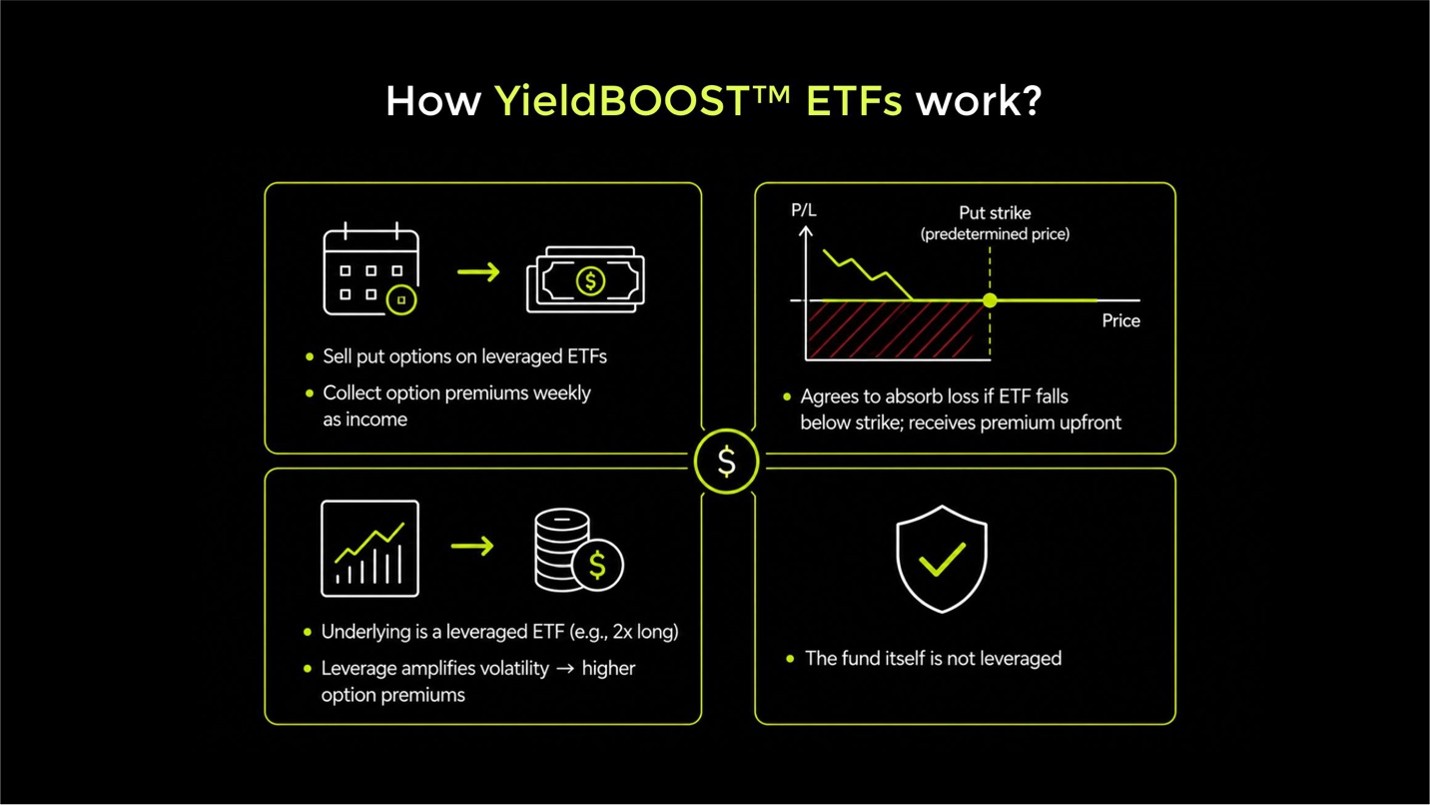
A range of GraniteShares ETFs that use a put spread strategy to generate high income. This involves selling near-the-money put options on leveraged ETFs and buying further out-of-the-money puts to limit downside risk. YieldBoost ETFs are not leveraged themselves but benefit from the higher premiums on options linked to leveraged ETFs. The strategy distributes income weekly and seeks to offer enhanced yields with built-in risk control.
Option(s)
A contract granting the buyer the right but not the obligation to buy (call) or sell (put) an underlying asset at a specified price before a set expiration date. GraniteShares uses options in certain strategies to generate income, manage exposure, or provide enhanced yield.
Put Option
The right, but not the obligation, to sell an underlying asset at a predetermined price within a specified time period. Often used for hedging or income strategies.
Covered‑Call Strategy
An income-focused investment approach that involves holding a long position in an underlying asset (such as an ETF or stock) and selling call options on that asset. GraniteShares uses this strategy in products like YieldBoost to capture premiums and generate additional yield.
Call Option
The right, but not the obligation, to buy an underlying asset at a predetermined price within a specified time period.
Flex Options
Customized options contracts traded on an exchange but with flexible terms such as expiration date, strike price, and settlement style. Commonly used by institutional investors.
30-Day SEC Yield:
The 30-Day SEC Yield represents the net investment income (excluding option income) earned by the ETF over the 30-day period ended [Most recent day the 30-SEC was provided]. It is expressed as an annualized percentage rate based on the ETF’s share price at the end of that period. This metric does not reflect the total income generated by the fund, as it excludes option premium income central to the YieldBOOST strategy.
Distribution Rate
The Distribution Rate shown is as of based of the NAV per share as of [day before declaration date] adjusted for corporate actions. the Distribution Rate is the annual rate an investor would receive if the most recent distribution remained the same going forward. The rate represents a single distribution from the fund and does not represent total return to the fund. The distribution rate is calculated by annualizing the most recent distribution and dividing it by the most recent NAV adjusted for corporate actions.
Ex-Date (Ex-Dividend Date)
The date on which an ETF trades without the value of its next distribution. Investors must purchase shares before the ex-date to be eligible to receive the upcoming distribution. Purchases on or after the ex-date will not qualify for the payout.
Record Date
The date set by the fund to determine which shareholders are entitled to receive a declared distribution. Investors listed as shareholders on the record date having purchased before the ex-date will receive the payout.
Pay Date
The date on which the ETF pays out the distribution to eligible shareholders. YieldBoost ETFs typically distribute income weekly, though payment schedules may vary based on fund structure and calendar timing.
Volatility
A statistical measure of the dispersion of returns for a given asset. Higher volatility indicates greater price fluctuations and is a key consideration in options pricing.
Liquidity
The ease with which an asset can be bought or sold in the market without affecting its price. ETFs typically have two layers of liquidity: the liquidity of the ETF shares and the underlying assets.
Expense Ratio
The annual fee expressed as a percentage of assets that investors pay for fund management and operations. It impacts the net return to investors.
Creation/Redemption Mechanism
The process by which ETFs issue and redeem shares in large blocks (creation units) through authorized participants, helping to keep the ETF’s market price close to its NAV.
Risk Disclosure
Information provided to investors about the potential risks involved in an investment product. This is a regulatory requirement, especially for complex products like leveraged or options-based ETFs.
About this privacy notice
For the purposes of data protection law, GraniteShares is a data controller in respect of your personal data. GraniteShares is responsible for ensuring that it uses your personal data in compliance with data protection law.
This privacy notice applies to clients of GraniteShares, investors or potential investors in GraniteShares exchange traded products (ETPs) and any other relevant persons. This privacy notice sets out the basis on which any personal data about you that you provide to us, that GraniteShares creates, or that GraniteShares obtains about you from other sources, will be processed by GraniteShares. Please take the time to read and understand this privacy notice.
Personal data that GraniteShares collects about you
GraniteShares will collect and process the following personal data about you:
- Information that you provide to GraniteShares or one of its affiliates. This includes information about you that you give GraniteShares by filling in forms or by communicating with GraniteShares, whether face-to-face, by phone, e-mail or otherwise. This information may include, without limitation, your name, address, gender, job title, telephone number, email address and other contact details and in certain circumstances may also include information supporting any KYC (know your customer) and AML (anti-money laundering) checks GraniteShares, its affiliates or delegates may be required to conduct from time to time.
- Information GraniteShares collects or generates about you. This includes:
- information that you provide to GraniteShares and which GraniteShares record in its CRM (customer relationship management) systems or otherwise store in our email or file server systems and any further automated back-up of such information by our IT systems;
- information that you provide to GraniteShares and that GraniteShares is required to record pursuant to its various compliance and regulatory obligations, including data (including financial information) that GraniteShares is required to collect or generate to ensure compliance with local marketing laws or regulations;
- information that is collected and stored as a result of any recording of GraniteShares Limited’s telephone lines;
- any information GraniteShares may record as a result of you accessing GraniteShares’ website.
- Information GraniteShares obtains from other sources.
- GraniteShares may obtain information about you from third party data research sources, such personal data may include your name, role, firm name, email address, online profile, URL and business address.
Uses of your personal data
Your personal data may be stored and processed by GraniteShares in the following ways and for the following purposes:
- processing for advertising, marketing and business development opportunities, of GraniteShares ETPs, including notifying you of information ;
- processing for public relations, including promoting public relations in connection with GraniteShares ETPs, including by use of GraniteShares’ website;
- in order for GraniteShares and its affiliates to comply with their respective legal, regulatory and compliance obligations; and
- any other purposes reasonably related to the above.
GraniteShares and its officers are entitled to use your personal data in these ways because:
- of legal and regulatory obligations that GraniteShares has to discharge;
- GraniteShares may need to establish, exercise or defend its legal rights or for the purpose of legal proceedings; or
- the use of your personal data as described is necessary for GraniteShares’ legitimate business interests (or the legitimate interests of one or more of our affiliates), such as:
- the performance of any contract in place between you (as the data subject) and GraniteShares (as data controller);
- compliance with the legal obligations of GraniteShares;
- GraniteShares’ legitimate interests which may include, without limitation, processing for direct marketing purposes and identifying business development opportunities, transmission of personal data (including data on clients, investors and potential investors in GraniteShares ETPs) within the GraniteShares’ group for internal administrative purposes, processing for ensuring cyber security and processing for reporting possible criminal acts or threats to public security to a competent authority;
- you may, from time to time, consent to GraniteShares using your personal data for one or more processing activities
Data Security and Integrity
GraniteShares looks to ensure that data is accurate, complete, current and reliable for its intended use. GraniteShares uses appropriate technical and organisational measures and safeguards to help protect your personal data from unauthorised access, misuse, alteration or loss. GraniteShares’ internal policies and procedures are designed to help ensure GraniteShares safeguards the privacy and accuracy of all data collected or processed.
Disclosure of your information to third parties
GraniteShares may disclose all or certain of your personal data to our affiliates (including, without limitation, GraniteShares Inc) in the circumstances described below:
- where GraniteShares has legal and regulatory obligations to discharge;
- GraniteShares may need to in order to establish, exercise or defend its legal rights or for the purpose of legal proceedings;
- in the course of ensuring the performance of any contract in place between you and GraniteShares;
- for direct marketing or business development purposes;
- for internal administrative purposes, including as a result of sharing common IT, call recording and data archiving systems; or
- for ensuring cyber security and processing for reporting possible criminal acts or threats to public security to a competent authority.
GraniteShares will take steps to ensure that the personal data is accessed only by staff of such affiliates that have a need to do so for the purposes described in this notice. GraniteShares may also share your personal data with non-affiliated third parties.
- if GraniteShares sells any of our business or assets, in which case GraniteShares may be asked to disclose your personal data to the prospective buyer for due diligence purposes
- if GraniteShares or any of its affiliates is acquired by a third party or are otherwise subject to outside investment, in which case personal data held by GraniteShares about you will be disclosed to the third party buyer or investor;
- to third party agents or contractors (for example, the providers of our IT and electronic data storage services) for the purposes of providing services to GraniteShares. These third parties will be subject to confidentiality requirements and they will only use your personal data as described in this privacy notice; and
- to the extent required by law, for example if GraniteShares is under a duty to disclose your personal data in order to comply with any legal obligation, establish, exercise or defend our legal rights.
Transfers of personal data outside the European Economic Area
The personal data that GraniteShares collects from you may be transferred to, and stored at, a destination outside the European Economic Area (“EEA”). It may also be processed by staff operating outside of the EEA who work for our affiliates or for one of our suppliers.
Where GraniteShares transfers your personal data outside the EEA, it will ensure that it is protected in a manner that is consistent with how your personal data will be protected by GraniteShares in the EEA. This can be done in a number of ways, for instance:
- the country that GraniteShares sends the data to might be approved by the European Commission
- the recipient might have signed up to a contract based on “model contractual clauses” approved by the European Commission, obliging them to protect your personal data; or
- where the recipient is located in the US, it might be a certified member of the EU-US Privacy Shield scheme.
In other circumstances the law may permit GraniteShares to otherwise transfer your personal data outside the EEA. In all cases, however, GraniteShares will ensure that any transfer of your personal data is compliant with data protection law.
You can obtain more details of the protection given to your personal data when it is transferred outside the EEA by contacting GraniteSharesin accordance with the “Contacting GraniteShares” section below.
Retention of personal data
How long GraniteShares holds your personal data for will vary. The retention period will be determined by various criteria including:
- the purpose for which GraniteShares is using it – GraniteShares will need to keep the data for as long as is necessary for that purpose; and
- legal obligations – laws or regulation may set a minimum period for which GraniteShares have to keep your personal data.
Your rights
You have a number of legal rights in relation to the personal data that GraniteShares holds about you.
These rights include:
- the right to obtain information regarding the processing of your personal data and access to the personal data which GraniteShares holds about you;
- the right to withdraw your consent to our processing of your personal data at any time. Please note, however, that GraniteShares may still be entitled to process your personal data if GraniteShares has another legitimate reason (other than consent) for doing so;
- in some circumstances, the right to receive some personal data in a structured, commonly used and machine-readable format and/or request that GraniteShares transmits those data to a third party where this is technically feasible. Please note that this right only applies to personal data which you have provided to GraniteShares;
- the right to request that GraniteShares rectifies your personal data if it is inaccurate or incomplete;
- the right to request that GraniteShares erases your personal data in certain circumstances. Please note that there may be circumstances where you ask GraniteShares to erase your personal data but GraniteShares is legally entitled to retain it;
- the right to object to, and the right to request that GraniteShares restricts, the processing of your personal data in certain circumstances. Again, there may be circumstances where you object to, or ask GraniteShares to restrict, the processing of your personal data but GraniteShares is legally entitled to continue processing your personal data and / or to refuse that request; and
- the right to lodge a complaint with the data protection regulator (details of which are provided below) if you think that any of your rights have been infringed by us.
You can exercise your rights by contacting GraniteShares using the details set out in the “Contacting GraniteShares” section below.
You can find out more information about your rights by contacting the Information Commissioner’s Office, or by searching their website at https://ico.org.uk/.
Changes to our privacy policy
Any changes GraniteShares makes to its privacy policy in the future will be posted on its website. GraniteShares suggests that from time-to-time you review this privacy policy for the latest information on GraniteShares’ privacy practices. By using GraniteShares’ website, you are agreeing to be bound by this privacy policy. GraniteShares keeps this privacy policy under regular review. This privacy policy was last updated in September 2024.
Contacting GraniteShares
If you would like further information on the collection, use, disclosure, transfer or processing of your personal data or the exercise of any of the rights listed above, please address questions, comments and requests to GraniteShares Limited, 3rd Floor, Great Titchfield House,14-18 Great Titchfield Street, London, Westminster, W1W 8BD, United Kingdom. (email: europe@graniteshares.com)
Cookies - Policy effective from 1 July 2020
GraniteShares may collect data about your computer, including, where available, your IP address, operating system and browser type, for system administration and other similar purposes. This is statistical data about users' browsing actions and patterns, and does not identify any individual user of the website. This is achieved by the use of cookies. A cookie is a small file of letters and numbers that is put on your computer if you agree to accept it. By clicking 'I Agree' below and entering the website you are consenting to the use of cookies as described here. These cookies allow you to be distinguished from other users of the website, which helps GraniteShares provide you with a better experience when you browse the website and also allows the website to be improved from time to time. Please note that you can adjust your browser settings to delete or block cookies, but you may not be able to access parts of the website without them. For more information, please read the Cookie Policy. A link to the policy is also available at the bottom of each page on the website
First party vs third party cookies
Cookies may be set by the site you are visiting or by another site prior to or during your visit. These are known as first and third party cookies.
First party cookies are set by GraniteShares and apply to the graniteshares.com website.
Third-party cookies belong to website domains different from graniteshares.com. Some web pages can feature content from third-party domains (such as banner ads). Other sites may also set cookies on your device during a visit to our site. These sites will be an approved partner, such as Google Analytics.
The cookies used by GraniteShares:
- Allow GraniteShares to provide you with access to the appropriate part of our website, for example by directing you to the right area depending on what country you have selected
- Allow GraniteShares to monitor your activities on our website and the pages you visit
- Allow GraniteShares to track how you arrive at our website and whether you have visited GraniteShares’ website from making a search, clicking on an advert or using a link in an email GraniteShares has sent
- Allow GraniteShares to obtain technical information about how you use our website, including the devices used and their geographical location
Types of cookies used
Session cookies are stored on your device only for the duration of your visit to our website or mobile app. As soon as you close your browser or turn off your device, session cookies are destroyed.
Persistent cookies remain on your device until they reach their expiry date (if applicable) or until you delete them. Once the cookie has expired or been deleted, it will be removed from your device. While a persistent cookie is on your device, it will be accessed each time you visit our website.
Cookie classification
Strictly necessary cookies are necessary for you to use the website because they allow GraniteShares to maintain your session on the website after you have accessed the site. GraniteShares is unable to provide our service without these cookies.
Marketing cookies track how you arrived on the GraniteShares website – letting GraniteShares track visitor trends and the sites visited before arriving at our website.
Performance cookies, including those provided by Google Analytics, track the number of visitors to our website, how long they spend on the website, the pages they visit and the journeys they take moving around our website. These cookies also track the performance of pages, website users’ interaction with these and the options on them and enable GraniteShares to test different design and content on our web pages. They also track the effectiveness of emails GraniteShares sends and how the website is used when a user has clicked through from an email campaign.
Functional cookies are used to improve functionality of our website and create a more personal experience by temporarily storing any information which you may enter such as language preferences, and, in some cases, remember information about you when you visit our site.
Website cookies
|
Name
|
Purpose
|
First or Third Party
|
Duration
|
Classification
|
|
_hstc
|
Used to track visitors
|
First party
|
13 months
|
|
|
hubspotutk
|
Used to keep track of a visitor’s identity and provide personalised content. This cookie is passed to HubSpot on form submission and used when deduplicating contacts.
|
First party
|
13 months
|
|
|
__hssc
|
Used to track sessions, determines if HubSpot should increment the session number and timestamps in the __hstc cookie. It contains the domain, viewCount (increments each pageView in a session), and session start timestamp.
|
First party
|
30 minutes
|
|
|
__hssrc
|
Whenever HubSpot changes the session cookie, this cookie is also set to determine if the visitor has restarted their browser. If this cookie does not exist, it is considered a new session. It contains the value "1" when present.
|
First party
|
Session
|
??
|
|
__ga
|
Used to distinguish users by Google Analytics
|
Third party
|
24 months
|
Performance/ analytics
|
|
__gat
|
Used to throttle request rate. If Google Analytics is deployed via Google Tag Manager, this cookie will be named _dc_gtm_<property-id>
|
Third party
|
1 minute
|
Performance/ analytics
|
|
__utma
|
Used to distinguish users and sessions. The cookie is created when the javascript library executes and no existing __utma cookies exists. The cookie is updated every time data is sent to Google Analytics
|
Third party
|
2 years from set/update
|
Performance/ analytics
|
|
__utmt
|
Used to throttle request rate.
|
Third party
|
10 minutes
|
Performance/ analytics
|
|
__utmb
|
Used to determine new sessions/visits. The cookie is created when the javascript library executes and no existing __utmb cookies exists. The cookie is updated every time data is sent to Google Analytics.
|
Third party
|
30 minutes
|
Performance/ analytics
|
|
__utmc
|
Not used in ga.js. Set for interoperability with urchin.js. Historically, this cookie operated in conjunction with the __utmb cookie to determine whether the user was in a new session/visit.
|
Third party
|
End of browser session
|
Performance/ analytics
|
|
__utmz
|
Stores the traffic source or campaign that explains how the user reached your site. The cookie is created when the javascript library executes and is updated every time data is sent to Google Analytics.
|
Third party
|
6 months from set/update
|
Performance/ analytics
|
|
__utmv
|
Used to store visitor-level custom variable data. The cookie is updated every time data is sent to Google Analytics.
|
Third party
|
2 years from set/update
|
Performance/ analytics
|
Other third-party cookies
Our web pages may contain content from third party sites such as Anchor, BrightTALK, Vimeo, YouTube, which may set their own cookies. Also, if you share a link to a page on the website, the service you share it on may set a cookie on your browser. GraniteShares has no control over third party cookies.
Web beacons
Some emails GraniteShares sends you, and some pages on GraniteShares’ website, may contain electronic images known as web beacons. These allow GraniteShares to track and assess the effectiveness of a particular campaign, and tell whether or not you’ve opened a particular email. If you don’t want to receive web beacons, you’ll need to disable HTML images or refuse HTML (select Text only) emails via your email software.
How you can manage cookies
You can set your browser to notify you when you receive a cookie, so you can decide whether or not to accept it. You can find information about how to set your browser at the following websites:
Microsoft Internet Explorer
Mozilla Firefox
Google Chrome
Apple Safari
iOS
To opt out of being tracked by Google Analytics across all websites Visit Google Opt Out Page.
To find out about the cookie policy of social media platforms and how to manage them:
Twitter cookies
LinkedIn cookies
Bing cookies
Google Adwords cookies
More information about cookies is available at All about cookies.
To opt out of receiving targeted advertisements, visit Network advertising choices or the DAA opt-out page or the EDAA opt-out page.
Please note that if you choose not to accept cookies from us, you may experience difficulties using the GraniteShares website.
Updates to this cookie policy
GraniteShares will update this policy from time to time. You should regularly return to this page so you can review any changes GraniteShares makes and see details of any new cookies GraniteShares added. The effective date of this cookie policy will always be shown at the top of the section.
General Website Use Disclaimers
GraniteShares Inc ("Granite Shares") makes the information on this website ("site") available as a service to visitors, to be used for informational purposes only.
General Product/Performance Disclaimers
This site is published for residents of specified countries. Investors are subject to securities and tax regulations within their applicable jurisdictions that are not addressed on this site. Nothing on this site should be considered a solicitation to buy or an offer to sell shares of any investment in any jurisdiction where the offer or solicitation would be unlawful under the securities laws of such jurisdiction. Nor is it intended as investment, tax, financial or legal advice. Investors should seek such professional advice for their particular situation.
Important Information for Foreign Investors
Because of the global nature of the Internet, you agree to comply with all local rules with respect to your account and your online conduct, including all laws, rules, codes and regulations of the country in which you reside and the country from which you access this site, including without limitation, all laws, rules, codes, regulations, decrees, acts, orders, directives, legislation, bills, and statutes pertaining to tax, contracts, intellectual property, securities, e-commerce, banking, technology, computers, fraud and privacy. In addition, you agree to comply with all applicable laws, rules, codes, and regulations regarding the transmission of technical data.
Professional Investors
Professional Investors are investors who possess sufficient experience, knowledge and expertise to make their own investment decisions and properly assess the risks that they incur. We consider the following investors professional Investors:
- Enterprises which are required to be authorised or regulated to operate in the financial markets, including:
- investment services enterprises;
- other authorised or supervised financial institutions;
- insurance undertakings;
- collective investment undertakings and their management companies;
- pension funds and management companies of such funds;
- enterprises within the meaning of section 2a (1) no. 8;
- exchange traders and commodity derivatives dealers;
- other institutional investors whose main business is not covered by (a) to (g) ,are subject to authorisation orsupervision requirements.
- Enterprises which are not subject to authorisation or supervision requirements under no. 1 and exceed at least two of the following three criteria:
- balance sheet total of EUR 20,000,000
- net turnover of EUR 40,000,000
- own funds of EUR 2,000,000
- National and regional governments as well as public bodies that manage public debt.
- Central Banks, international and supranational institutions such as the World Bank, the International Monetary Fund, the European Central Bank, the European Investment Bank and other similar international organisations.
- Other institutional investors which are not subject to authorisation or supervision requirements and whose main activity is to invest in financial instruments, and entities offering the securitisation of assets and other financing transactions.
Individual investors are generally not categorised as Professional Investors. However, an individual investor may be categorised as professional Investor upon request to GraniteShares. GraniteShares may categorise an individual investor as professional investor only after an individual assessment has been conducted as to whether the client possesses the experience, knowledge and expertise to make an investment decision in general or with respect to a specific type of transaction, and if he is capable of adequately assessing the risks involved. GraniteShares will generally not categorise an individual investor as professional investor if the individual investor does not satisfy, as a minimum, two of the following three criteria:
- the investor has carried out transactions, in significant size, on the market on which the financial instruments are traded for which he is intended to be categorised as professional investor, at an average frequency of 10 per quarter over the previous year.
- the investor’s cash deposits and financial instruments exceed EUR 500,000.
- the investor has worked in the capital market for at least one year in a professional position which requires knowledge of the transactions, investment services and ancillary services envisaged.
An individual investor may only rely on a categorisation as Professional Investor if GraniteShares has, firstly, informed the individual investor in writing about such categorisation and the fact that the protection provisions relating to individual investors no longer apply, and secondly, the investor has confirmed in writing that he has been informed of this fact. Where an individual investor who is categorised as a Professional
Investor does not keep GraniteShares informed about any change which may affect his categorisation as a Professional Investor, any erroneous categorisation as Professional Investor made on this basis shall not constitute a breach of duty on the part of GraniteShares.
This website and its content has been provided by GraniteShares.
General Notice
This document does not constitute an offer to buy or sell or a solicitation of an offer to buy securities in any company. This document is not intended for distribution to any other country where such distribution or use would be contrary to local law or regulation. Specifically, this document is not intended for general distribution in the United States or Canada.
Investing in financial markets involves a substantial degree of risk. Nothing described herein is intended to imply that an investment is “safe”, “conservative”, “risk free” or “risk averse”. This document does not consider the specific investment objective, financial situation or particular needs of any potential investor and is intended only for those investors who are capable of understanding the risk of loss of all or a substantial part of their monies. Potential investors in the UK are reminded that they will not benefit from the UK investors compensation scheme.
Nothing contained herein constitutes investment, legal, tax or other advice nor is to be relied upon in making an investment or other decision. No recommendation is made positive or otherwise, regarding individual securities or investments mentioned herein. Any summary list of risk factors does not purport to be a complete enumeration or explanation of the risks involved in an investment in short and leveraged products. Prospective investors must consult with their own legal, tax and financial advisers before deciding to invest.
This document contains the opinions of the author and such opinions are subject to change without notice. The source of data is GraniteShares unless otherwise stated. No guarantee is made to the accuracy of the information provided which has been obtained from sources believed to be reliable. This document and the information contained herein is intended only for the use of persons (or entities they represent) to whom it has been provided.
Risk Factors
An investment in a GraniteShares short and leveraged exchange traded product (“ETP”) may not be suitable for all investors. They are intended for investors who wish to take a very short term view on the underlying asset and are not intended as buy and hold investments.
Performance and capital loss: Past performance is not a reliable indicator of future results. The value of an investment may go down as well as up and can result in losses, up and including a total loss of the amount initially invested.
Generic risks: Investments in ETPs involve numerous risks including, among others, company risks, general market risks, credit risks, foreign exchange risks, interest rate risks, geopolitical risks and liquidity risks.
Specific product risks: The Index is constructed to track the performance of an increased (leveraged) and/or short exposure to the underlying asset. A fall (or rise where short and leveraged exposure) in value of the underlying asset can result in a greater reduction in the level of the Index. The Index is designed to do this on a daily basis only which should not be equated with seeking a leveraged position for periods longer than a day. The ETP’s performance over periods longer than one day will not be correlated or symmetrical with the returns of the underlying asset. Potential investors should refer to the section entitled “Risk Factors” and “Economic Overview of the ETP Securities” in the Prospectus relating to the GraniteShares ETPs for further details of these and other risks associated with an investment in short and leveraged ETPs and consult their financial advisers as needed.
Counterparty risk: An investment in a GraniteShares short and leveraged ETP involves counterparty risk. GraniteShares Financial plc has entered into a Swap Agreement with a counterparty, Natixis, that is backed with collateral. Failure of the counterparty to make payments may result in an investment in an ETP suffering a loss.
Index Disclaimer
The Index is created, calculated and published by Solactive AG. No financial instrument is sponsored, promoted, sold or supported in any other manner by Solactive AG nor does Solactive AG offer any express or implicit guarantee or assurance either with regard to the results of using the Index and/or Index trade mark or the Index level at any time or in any other respect.
„GraniteShares Limited“, „wir“, „uns“ und„unser“„GraniteShares Limited“, „wir“, „uns“ und „unser“ bedeutet GraniteShares Limited und wir verpflichten uns, Ihre Privatsphäre zu respektieren.
GraniteShares Limited ist im Vereinigten Königreich registriert und hat die registrierte Adresse: 2nd Floor, 167-169 Great Portland Street, London, England, W1W 5PF. Die Firmenregistrierungsnummer von GraniteShares Limited lautet 10909672.
Über diese Datenschutzerklärung
Im Sinne des Datenschutzgesetzes ist GraniteShares Limited ein Datenverantwortlicher in Bezug auf Ihre personenbezogenen Daten. GraniteShares Limited ist dafür verantwortlich sicherzustellen, dass Ihre personenbezogenen Daten in Übereinstimmung mit dem Datenschutzgesetz verwendet werden.
Diese Datenschutzerklärung gilt für Kunden von GraniteShares Limited, Investoren oder potenzielle Investoren in börsengehandelte Produkte (ETPs) von GraniteShares und alle anderen relevanten Personen. Diese Datenschutzerklärung legt die Grundlage dar, auf der alle personenbezogenen Daten über Sie, die Sie uns zur Verfügung stellen, die wir erstellen oder die wir aus anderen Quellen über Sie erhalten, von uns verarbeitet werden. Bitte nehmen Sie sich die Zeit, diese Datenschutzerklärung zu lesen und zu verstehen.
Personenbezogene Daten, die wir über Sie erheben
Wir erheben und verarbeiten die folgenden personenbezogenen Daten über Sie:
- Informationen, die Sie uns oder einem unserer verbundenen Unternehmen zur Verfügung stellen. Dazu gehören Informationen über Sie, die Sie uns durch Ausfüllen von Formularen oder durch Kommunikation mit uns übermitteln, ob persönlich, telefonisch, per E-Mail oder auf andere Weise. Diese Informationen können ohne Einschränkung Ihren Namen, Ihre Adresse und Ihr Geschlecht enthalten , Berufsbezeichnung, Telefonnummer, E-Mail-Adresse und andere Kontaktdaten und können unter bestimmten Umständen auch Informationen enthalten, die KYC- (Know Your Customer) und AML- (Geldwäschebekämpfung) Überprüfungen unterstützen, die wir, unsere verbundenen Unternehmen oder Beauftragten möglicherweise durchführen müssen von Zeit zu Zeit.
- Informationen, die wir über Sie sammeln oder generieren. Das beinhaltet:
- Informationen, die Sie uns zur Verfügung stellen und die wir in unseren CRM-Systemen (Customer Relationship Management) aufzeichnen oder anderweitig in unseren E-Mail- oder Dateiserversystemen speichern, sowie alle weiteren automatisierten Sicherungen dieser Informationen durch unsere IT-Systeme;
- Informationen, die Sie uns zur Verfügung stellen und die wir gemäß unseren verschiedenen Compliance- und regulatorischen Verpflichtungen aufzeichnen müssen, einschließlich Daten (einschließlich Finanzinformationen), die wir sammeln oder generieren müssen, um die Einhaltung lokaler Marketinggesetze oder -vorschriften sicherzustellen;
- Informationen, die infolge einer Aufzeichnung der Telefonleitungen von GraniteShares Limited gesammelt und gespeichert werden;
- alle Informationen, die wir möglicherweise aufgrund Ihres Zugriffs auf unsere Website erfassen.
- Informationen, die wir aus anderen Quellen erhalten.
- Wir können Informationen über Sie aus Datenforschungsquellen Dritter erhalten, solche personenbezogenen Daten können Ihren Namen, Ihre Rolle, Ihren Firmennamen, Ihre E-Mail-Adresse, Ihr Online-Profil, Ihre URL und Ihre Geschäftsadresse enthalten.
Verwendung Ihrer personenbezogenen Daten
Ihre personenbezogenen Daten können von GraniteShares Limited auf folgende Weise und für die folgenden Zwecke gespeichert und verarbeitet werden:
- Verarbeitung für Werbe-, Marketing- und Geschäftsentwicklungsmöglichkeiten, einschließlich Werbung, Geschäftsentwicklung oder Marketing von GraniteShares ETPs, einschließlich der Benachrichtigung über Informationen (einschließlich per E-Mail) darüber;
- Verarbeitung für die Öffentlichkeitsarbeit, einschließlich der Förderung der Öffentlichkeitsarbeit im Zusammenhang mit GraniteShares ETPs, einschließlich durch Nutzung der Website von GraniteShares Limited;
- damit GraniteShares Limited und seine verbundenen Unternehmen ihre jeweiligen gesetzlichen, regulatorischen und Compliance-Verpflichtungen erfüllen können; und
- alle anderen Zwecke, die vernünftigerweise mit den oben genannten in Verbindung stehen.
- Wir sind berechtigt, Ihre personenbezogenen Daten auf diese Weise zu verwenden, weil:
- Wir haben gesetzliche und behördliche Verpflichtungen, denen wir nachkommen müssen;
- Wir müssen dies möglicherweise tun, um unsere gesetzlichen Rechte zu begründen, auszuüben oder zu verteidigen oder um Gerichtsverfahren durchzuführen; oder
- Die Verwendung Ihrer personenbezogenen Daten wie beschrieben ist für unsere berechtigten Geschäftsinteressen (oder die berechtigten Interessen eines oder mehrerer unserer verbundenen Unternehmen) erforderlich, wie zum Beispiel:
- die Erfüllung eines Vertrages zwischen Ihnen (als betroffene Person) und GraniteShares Limited (als Datenverantwortlicher);
- Einhaltung der gesetzlichen Verpflichtungen von GraniteShares Limited;
- Die legitimen Interessen von GraniteShares Limited, die ohne Einschränkung die Verarbeitung für Direktmarketingzwecke und die Identifizierung von Geschäftsentwicklungsmöglichkeiten, die Übermittlung personenbezogener Daten (einschließlich Daten über Kunden, Anleger und potenzielle Anleger in GraniteShares ETPs) innerhalb der GraniteShares-Gruppe für interne Verwaltungszwecke umfassen können, Verarbeitung zur Gewährleistung der Cybersicherheit und Verarbeitung zur Meldung möglicher krimineller Handlungen oder Bedrohungen der öffentlichen Sicherheit an eine zuständige Behörde;
- Sie können uns von Zeit zu Zeit zustimmen, Ihre personenbezogenen Daten für eine oder mehrere Verarbeitungsaktivitäten zu verwenden
Datensicherheit und Integrität
Wir bemühen uns sicherzustellen, dass die Daten für den vorgesehenen Verwendungszweck genau, vollständig, aktuell und zuverlässig sind. Wir verwenden geeignete technische und organisatorische Maßnahmen und Sicherheitsvorkehrungen, um Ihre personenbezogenen Daten vor unbefugtem Zugriff, Missbrauch, Veränderung oder Verlust zu schützen. Unsere internen Richtlinien und Verfahren sollen sicherstellen, dass wir die Privatsphäre und Genauigkeit aller von uns erfassten oder verarbeiteten Daten schützen.
Weitergabe Ihrer Daten an Dritte
Unter den nachstehend beschriebenen Umständen können wir alle oder bestimmte Ihrer personenbezogenen Daten an unsere verbundenen Unternehmen (einschließlich, aber nicht beschränkt auf GraniteShares Inc) weitergeben:
- wo wir gesetzliche und behördliche Verpflichtungen haben, denen wir nachkommen müssen;
- Wir müssen dies möglicherweise tun, um unsere gesetzlichen Rechte zu begründen, auszuüben oder zu verteidigen oder um Gerichtsverfahren durchzuführen;
- im Zuge der Sicherstellung der Erfüllung eines zwischen uns bestehenden Vertrages;
- für Direktmarketing- oder Geschäftsentwicklungszwecke;
- für interne Verwaltungszwecke, einschließlich als Folge der gemeinsamen Nutzung gemeinsamer IT-, Gesprächsaufzeichnungs- und Datenarchivierungssysteme; oder
- zur Gewährleistung der Cybersicherheit und Verarbeitung zur Meldung möglicher krimineller Handlungen oder Bedrohungen der öffentlichen Sicherheit an eine zuständige Behörde.
- Wir werden Maßnahmen ergreifen, um sicherzustellen, dass nur Mitarbeiter solcher verbundenen Unternehmen auf die personenbezogenen Daten zugreifen, die dies für die in dieser Erklärung beschriebenen Zwecke benötigen. Wir können Ihre personenbezogenen Daten auch außerhalb von GraniteShares Limited und unseren verbundenen Unternehmen weitergeben
- wenn wir eines unserer Geschäfte oder Vermögenswerte verkaufen, in diesem Fall werden wir möglicherweise aufgefordert, Ihre personenbezogenen Daten zu Due-Diligence-Zwecken an den potenziellen Käufer weiterzugeben
- wenn wir von einem Dritten erworben werden oder anderweitig einer externen Investition unterliegen, werden in diesem Fall von uns über Sie gespeicherte personenbezogene Daten an den Drittkäufer oder Investor weitergegeben;
- an Dritte oder Auftragnehmer (z. B. die Anbieter unserer IT- und elektronischen Datenspeicherungsdienste) zum Zweck der Erbringung von Dienstleistungen für uns. Diese Drittparteien unterliegen Vertraulichkeitsanforderungen und werden Ihre personenbezogenen Daten nur wie in dieser Datenschutzerklärung beschrieben verwenden; und
- im gesetzlich vorgeschriebenen Umfang, beispielsweise wenn wir verpflichtet sind, Ihre personenbezogenen Daten offenzulegen, um einer gesetzlichen Verpflichtung nachzukommen, unsere gesetzlichen Rechte zu begründen, auszuüben oder zu verteidigen.
Übermittlung personenbezogener Daten außerhalb des Europäischen Wirtschaftsraums
Die personenbezogenen Daten, die wir von Ihnen erheben, können an einen Ort außerhalb des Europäischen Wirtschaftsraums („EWR“) übertragen und dort gespeichert werden. Sie können auch von Mitarbeitern verarbeitet werden, die außerhalb des EWR tätig sind und für unsere verbundenen Unternehmen oder einen unserer Lieferanten arbeiten.
Wenn wir Ihre personenbezogenen Daten außerhalb des EWR übertragen, stellen wir sicher, dass sie in einer Weise geschützt sind, die mit der Art und Weise übereinstimmt, wie Ihre personenbezogenen Daten von uns im EWR geschützt werden. Dies kann beispielsweise auf verschiedene Weise erfolgen:
- Das Land, in das wir die Daten senden, kann von der Europäischen Kommission genehmigt werden
- der Empfänger hat möglicherweise einen Vertrag auf der Grundlage von „Mustervertragsklauseln“ unterzeichnet, die von der Europäischen Kommission genehmigt wurden und ihn zum Schutz Ihrer personenbezogenen Daten verpflichten; oder
- Wenn sich der Empfänger in den USA befindet, kann es sich um ein zertifiziertes Mitglied des EU-US-Datenschutzschilds handeln.
Unter anderen Umständen kann uns das Gesetz erlauben, Ihre personenbezogenen Daten anderweitig außerhalb des EWR zu übermitteln. In jedem Fall stellen wir jedoch sicher, dass die Übermittlung Ihrer personenbezogenen Daten datenschutzkonform erfolgt.
Weitere Einzelheiten zum Schutz Ihrer personenbezogenen Daten bei der Übertragung außerhalb des EWR erhalten Sie, indem Sie uns gemäß dem nachstehenden Abschnitt „Kontaktaufnahme“ kontaktieren.
Aufbewahrung personenbezogener Daten
Wie lange wir Ihre personenbezogenen Daten speichern, ist unterschiedlich. Die Aufbewahrungsfrist wird anhand verschiedener Kriterien bestimmt, darunter::
- den Zweck, für den wir sie verwenden – wir müssen die Daten so lange aufbewahren, wie es für diesen Zweck erforderlich ist; und
- Gesetzliche Verpflichtungen – Gesetze oder Vorschriften können einen Mindestzeitraum festlegen, für den wir Ihre personenbezogenen Daten aufbewahren müssen.
Deine Rechte
Sie haben eine Reihe von gesetzlichen Rechten in Bezug auf die personenbezogenen Daten, die wir über Sie gespeichert haben.
Zu diesen Rechten gehören:
- das Recht, Informationen über die Verarbeitung Ihrer personenbezogenen Daten und Zugang zu den personenbezogenen Daten zu erhalten, die wir über Sie gespeichert haben;
- das Recht, Ihre Zustimmung zu unserer Verarbeitung Ihrer personenbezogenen Daten jederzeit zu widerrufen. Bitte beachten Sie jedoch, dass wir weiterhin berechtigt sein können, Ihre personenbezogenen Daten zu verarbeiten, wenn wir einen anderen legitimen Grund (außer der Einwilligung) dafür haben;
- unter bestimmten Umständen das Recht, einige personenbezogene Daten in einem strukturierten, allgemein gebräuchlichen und maschinenlesbaren Format zu erhalten und/oder zu verlangen, dass wir diese Daten an einen Dritten übermitteln, sofern dies technisch machbar ist. Bitte beachten Sie, dass dieses Recht nur für personenbezogene Daten gilt, die Sie uns zur Verfügung gestellt haben;
- das Recht zu verlangen, dass wir Ihre personenbezogenen Daten berichtigen, wenn sie unrichtig oder unvollständig sind;
- das Recht zu verlangen, dass wir Ihre personenbezogenen Daten unter bestimmten Umständen löschen. Bitte beachten Sie, dass es Umstände geben kann, unter denen Sie uns auffordern, Ihre personenbezogenen Daten zu löschen, wir jedoch gesetzlich dazu berechtigt sind, sie aufzubewahren;
- das Recht auf Widerspruch und das Recht zu verlangen, dass wir unsere Verarbeitung Ihrer personenbezogenen Daten unter bestimmten Umständen einschränken. Auch hier kann es Umstände geben, unter denen Sie unserer Verarbeitung Ihrer personenbezogenen Daten widersprechen oder uns bitten, diese einzuschränken, aber wir sind gesetzlich berechtigt, Ihre personenbezogenen Daten weiter zu verarbeiten und/oder diese Anfrage abzulehnen; und
- das Recht, eine Beschwerde bei der Datenschutzbehörde einzureichen (Details dazu finden Sie unten), wenn Sie der Meinung sind, dass eines Ihrer Rechte von uns verletzt wurde.
Sie können Ihre Rechte ausüben, indem Sie uns unter Verwendung der im nachstehenden Abschnitt „Kontaktaufnahme“ aufgeführten Angaben kontaktieren.
Weitere Informationen zu Ihren Rechten erhalten Sie, indem Sie sich an das Information Commissioner’s Office wenden oder dessen Website unter durchsuchen https://ico.org.uk/.
Änderungen unserer Datenschutzerklärung
Alle Änderungen, die wir in Zukunft an unserer Datenschutzrichtlinie vornehmen, werden auf unserer Website veröffentlicht. Wir empfehlen Ihnen, diese Datenschutzrichtlinie von Zeit zu Zeit zu lesen, um die neuesten Informationen zu unseren Datenschutzpraktiken zu erhalten. Durch die Nutzung unserer Website erklären Sie sich mit dieser Datenschutzerklärung einverstanden. Wir überprüfen diese Datenschutzerklärung regelmäßig. Diese Datenschutzerklärung wurde zuletzt im Januar 2019 aktualisiert.
Uns kontaktieren
Wenn Sie weitere Informationen über die Erhebung, Nutzung, Offenlegung, Übertragung oder Verarbeitung Ihrer personenbezogenen Daten oder die Ausübung eines der oben aufgeführten Rechte wünschen, wenden Sie sich bitte mit Fragen, Kommentaren und Anfragen an GraniteShares Limited, 1st Floor, 71-91 Aldwych , Aldwych House, London WC2B 4HN (email: europe@graniteshares.com)
Diese Website verwendet Cookies, die auf Ihrem Computer oder Mobilgerät platziert werden, um Ihre Erfahrung auf dieser Website zu verbessern. Indem Sie diese Website weiterhin nutzen, stimmen Sie unserer Verwendung von Cookies zu. Weitere Informationen darüber, wie wir Cookies verwenden und wie Sie Ihre Cookie-Einstellungen ändern und Google Analytics-Cookies deaktivieren können, finden Sie in unserer Cookie-Richtlinie. Ein Link zur Richtlinie ist auch unten auf jeder Seite der Website verfügbar
Diese Richtlinie gilt ab dem 1. Juli 2020
Wie viele andere Websites verwendet unsere Website Cookies. „Cookies“ sind kleine Informationseinheiten, die von einer Organisation an Ihren Computer gesendet und auf Ihrer Festplatte gespeichert werden, damit diese Website Sie bei Ihrem Besuch wiedererkennen kann. Sie sammeln statistische Daten über Ihre Browsing-Aktionen und -Muster und enthalten normalerweise keine Informationen, die Sie als Einzelperson identifizieren, aber alle persönlichen Informationen, die wir über Sie speichern, können mit den Informationen verknüpft werden, die in Cookies gespeichert und von Cookies erhalten werden. Cookies unterstützen die Seitennavigation und Website-Funktionalität. Dies hilft uns, unsere Website zu verbessern und einen besseren Service zu bieten.
Erstanbieter- und Drittanbieter-Cookies
Cookies können von der Website, die Sie besuchen, oder von einer anderen Website vor oder während Ihres Besuchs gesetzt werden. Diese werden als Erst- und Drittanbieter-Cookies bezeichnet.
Erstanbieter-Cookies werden von GraniteShares festgelegt und gelten für die Website graniteshares.com.
Cookies von Drittanbieterngehören zu anderen Website-Domains als graniteshares.com. Einige Webseiten können Inhalte von Domains Dritter enthalten (z. B. Werbebanner). Auch andere Websites können während eines Besuchs auf unserer Website Cookies auf Ihrem Gerät platzieren. Diese Websites werden ein genehmigter Partner sein, z. B. Google Analytics.
Die von GraniteShares verwendeten Cookies:
- Ermöglichen Sie uns, Ihnen Zugriff auf den entsprechenden Teil unserer Website zu gewähren, indem wir Sie beispielsweise je nach ausgewähltem Land zum richtigen Bereich leiten
- Erlauben Sie uns, Ihre Aktivitäten auf unserer Website und den von Ihnen besuchten Seiten zu überwachen
- Ermöglichen Sie uns zu verfolgen, wie Sie auf unsere Website gelangt sind und ob Sie uns über eine Suche, das Klicken auf eine Anzeige oder die Verwendung eines Links in einer von uns gesendeten E-Mail besucht haben
- Ermöglichen Sie uns, technische Informationen darüber zu erhalten, wie Sie unsere Website nutzen, einschließlich der verwendeten Geräte und ihres geografischen Standorts
Arten von verwendeten Cookies
Sitzungscookies werden nur für die Dauer Ihres Besuchs auf unserer Website oder mobilen App auf Ihrem Gerät gespeichert. Sobald Sie Ihren Browser schließen oder Ihr Gerät ausschalten, werden Sitzungscookies zerstört.
Persistente Cookies verbleiben auf Ihrem Gerät, bis sie ihr Ablaufdatum erreichen (falls zutreffend) oder bis Sie sie löschen. Sobald das Cookie abgelaufen ist oder gelöscht wurde, wird es von Ihrem Gerät entfernt. Solange sich ein dauerhaftes Cookie auf Ihrem Gerät befindet, wird bei jedem Besuch unserer Website darauf zugegriffen.
Cookie-Klassifizierung
Unbedingt erforderliche Cookies sind erforderlich, damit Sie die Website nutzen können, da sie es uns ermöglichen, Ihre Sitzung auf der Website aufrechtzuerhalten, nachdem Sie die Website aufgerufen haben. Ohne diese Cookies können wir unseren Service nicht anbieten.
Marketing-Cookies nachverfolgen, wie Sie auf die GraniteShares-Website gelangt sind – so können wir Besuchertrends und die besuchten Websites verfolgen, bevor Sie auf unsere Website gelangen.
Leistungs-Cookies, einschließlich der von Google Analytics bereitgestellten, verfolgen Sie die Anzahl der Besucher unserer Website, wie lange sie auf der Website verbringen, welche Seiten sie besuchen und welche Wege sie auf unserer Website unternehmen. Diese Cookies verfolgen auch die Leistung von Seiten, die Interaktion der Website-Benutzer mit diesen und die Optionen darauf und ermöglichen es uns, verschiedene Designs und Inhalte auf unseren Webseiten zu testen. Sie verfolgen auch die Effektivität von E-Mails, die wir senden, und wie die Website verwendet wird, wenn ein Benutzer von einer E-Mail-Kampagne durchgeklickt hat.
Funktionale Cookieswerden verwendet, um die Funktionalität unserer Website zu verbessern und ein persönlicheres Erlebnis zu schaffen, indem Informationen, die Sie möglicherweise eingeben, wie z. B. Spracheinstellungen, vorübergehend gespeichert werden, und in einigen Fällen Informationen über Sie gespeichert werden, wenn Sie unsere Website besuchen.
Website-Cookies
|
Name
|
Zweck
|
Erster oder Dritter
|
Dauer
|
Einstufung
|
|
_hstc
|
Wird verwendet, um Besucher zu verfolgen
|
Erste Party
|
13 Monate
|
|
|
hubspotutk
|
Wird verwendet, um die Identität eines Besuchers zu verfolgen und personalisierte Inhalte bereitzustellen. Dieses Cookie wird beim Absenden des Formulars an HubSpot übergeben und beim Deduplizieren von Kontakten verwendet.
|
Erste Party
|
13 Monate
|
|
|
__hssc
|
Wird zum Nachverfolgen von Sitzungen verwendet und bestimmt, ob HubSpot die Sitzungsnummer und die Zeitstempel im __hstc-Cookie erhöhen soll. Es enthält die Domäne, viewCount (erhöht jeden Seitenaufruf in einer Sitzung) und den Zeitstempel des Sitzungsstarts.
|
Erste Party
|
30 Minuten
|
|
|
__hssrc
|
Immer wenn HubSpot das Sitzungscookie ändert, wird dieses Cookie auch gesetzt, um festzustellen, ob der Besucher seinen Browser neu gestartet hat. Wenn dieses Cookie nicht existiert, wird es als neue Sitzung betrachtet. Es enthält den Wert "1", wenn vorhanden.
|
Erste Party
|
Sitzung
|
??
|
|
__ga
|
Wird verwendet, um Benutzer von Google Analytics zu unterscheiden
|
Dritte Seite
|
24 Monate
|
Leistung/Analyse
|
|
__gat
|
Wird verwendet, um die Anforderungsrate zu drosseln. Wenn Google Analytics über Google Tag Manager bereitgestellt wird, wird dieses Cookie benannt _dc_gtm_<property-id>
|
Dritte Seite
|
1 Minute
|
Leistung/Analyse
|
|
__utma
|
Wird verwendet, um Benutzer und Sitzungen zu unterscheiden. Das Cookie wird erstellt, wenn die Javascript-Bibliothek ausgeführt wird und nicht vorhanden ist __utma Cookies existieren. Das Cookie wird jedes Mal aktualisiert, wenn Daten an Google Analytics gesendet werden
|
Dritte Seite
|
2 Jahre ab Set/Update
|
Leistung/Analyse
|
|
__utmt
|
Wird verwendet, um die Anforderungsrate zu drosseln.
|
Dritte Seite
|
10 Minuten
|
Leistung/Analyse
|
|
__utmb
|
Wird verwendet, um neue Sitzungen/Besuche zu ermitteln. Das Cookie wird erstellt, wenn die Javascript-Bibliothek ausgeführt wird und keine vorhandenen __utmb-Cookies vorhanden sind. Das Cookie wird jedes Mal aktualisiert, wenn Daten an Google Analytics gesendet werden.
|
Dritte Seite
|
30 Minuten
|
Leistung/Analyse
|
|
__utmc
|
Wird in ga.js nicht verwendet. Auf Interoperabilität mit urchin.js eingestellt. In der Vergangenheit wurde dieses Cookie zusammen mit dem verwendet __utmb Cookie, um festzustellen, ob sich der Benutzer in einer neuen Sitzung/einem neuen Besuch befand.
|
Dritte Seite
|
Ende der Browsersitzung
|
Leistung/Analyse
|
|
__utmz
|
Speichert die Verkehrsquelle oder Kampagne, die erklärt, wie der Benutzer Ihre Website erreicht hat. Das Cookie wird erstellt, wenn die Javascript-Bibliothek ausgeführt wird, und jedes Mal aktualisiert, wenn Daten an Google Analytics gesendet werden.
|
Dritte Seite
|
6 Monate ab Set/Update
|
Leistung/Analyse
|
|
__utmv
|
Wird verwendet, um benutzerdefinierte variable Daten auf Besucherebene zu speichern. Das Cookie wird jedes Mal aktualisiert, wenn Daten an Google Analytics gesendet werden.
|
Dritte Seite
|
2 Jahre ab Set/Update
|
Leistung/Analyse
|
Anderes Drittel-Partykekse
OUnsere Webseiten können Inhalte von Websites Dritter wie Anchor, BrightTALK, Vimeo, YouTube enthalten, die möglicherweise ihre eigenen Cookies setzen. Auch wenn Sie einen Link zu einer Seite auf der Website teilen, kann der Dienst, auf dem Sie ihn teilen, ein Cookie in Ihrem Browser setzen. GraniteShares hat keine Kontrolle über Cookies von Drittanbietern.
Web-Beacons
Einige E-Mails, die wir Ihnen senden, und einige Seiten unserer Website können elektronische Bilder enthalten, die als Web-Beacons bekannt sind. Diese ermöglichen es uns, die Effektivität einer bestimmten Kampagne zu verfolgen und zu bewerten und uns mitzuteilen, ob Sie eine bestimmte E-Mail geöffnet haben oder nicht. Wenn Sie keine Web Beacons erhalten möchten, müssen Sie HTML-Bilder deaktivieren oder HTML-E-Mails (nur Text auswählen) über Ihre E-Mail-Software ablehnen.
Wie Sie Cookies verwalten können
Sie können Ihren Browser so einstellen, dass er Sie benachrichtigt, wenn Sie ein Cookie erhalten, sodass Sie entscheiden können, ob Sie es akzeptieren oder nicht. Informationen zur Einstellung Ihres Browsers finden Sie auf den folgenden Websites:
Microsoft Internet Explorer
Mozilla Firefox
Google Chrome
Apple Safari
iOS
Deaktivieren der Verfolgung durch Google Analytics auf allen Websites Google-Opt-out.
Um sich über die Cookie-Richtlinien von Social-Media-Plattformen und deren Verwaltung zu informieren:
Twitter cookies
LinkedIn cookies
Bing cookies
Google Adwords cookies
Weitere Informationen zu Cookies finden Sie unter allaboutcookies.org.
Um den Erhalt gezielter Werbung abzulehnen, besuchen Sie networkadvertising.org/choices oder die DAA-Deaktivierungsseite oder die EDAA-Deaktivierungsseite.
Bitte beachten Sie, dass Sie Schwierigkeiten bei der Nutzung der GraniteShares-Website haben können, wenn Sie keine Cookies von uns akzeptieren.
Aktualisierungen dieser Cookie-Richtlinie
Wir werden diese Richtlinie von Zeit zu Zeit aktualisieren. Sie sollten regelmäßig zu dieser Seite zurückkehren, damit Sie alle von uns vorgenommenen Änderungen überprüfen und Einzelheiten zu allen neuen Cookies sehen können, die wir hinzufügen. Das Datum des Inkrafttretens dieser Cookie-Richtlinie wird immer oben auf der Seite angezeigt.
Allgemeine Geschäftsbedingungen
Wichtiger Hinweis
Diese Website wird von GraniteShares Limited („GraniteShares“) betrieben, einer privaten Haftungsgesellschaft (eingetragen in England und Wales (Registrierungsnummer 10909672) mit eingetragenem Firmensitz in 3rd Floor, Great Titchfield House, 14-18 Great Titchfield Street, London, Westminster, W1W 8BD, Vereinigtes Königreich. GraniteShares .
Diese Website dient nur Ihrer allgemeinen Information und stellt keine Anlageberatung oder ein Angebot zum Kauf oder Verkauf oder die Aufforderung zur Abgabe eines Angebots zum Kauf einer Anlage dar.
Nichts auf dieser Website sollte als Beratung zu den Vorzügen eines Produkts oder einer Anlage ausgelegt werden. Nichts auf dieser Website stellt eine Anlage-, Rechts-, Steuer- oder sonstige Beratung dar und sollte nicht als Grundlage für eine Anlage- oder andere Entscheidung herangezogen werden. Hinsichtlich einzelner hierin erwähnter Produkte oder Anlagen wird keine positive oder sonstige Empfehlung ausgesprochen. Jede nachstehende zusammenfassende Liste von Risikofaktoren erhebt nicht den Anspruch, eine vollständige Aufzählung oder Erläuterung der mit einer Anlage verbundenen Risiken zu sein. Potenzielle Anleger sollten eine unabhängige Anlageberatung einholen und sich über geltende gesetzliche Anforderungen, Devisenkontrollvorschriften und Steuern in ihrer Gerichtsbarkeit informieren. Potenzielle Anleger müssen sich mit ihren eigenen Rechts-, Steuer- und Finanzberatern beraten, bevor sie sich für eine Anlage entscheiden.
Diese Website entspricht den regulatorischen Anforderungen des Vereinigten Königreichs. Es kann Gesetze in Ihrem Land Ihrer Staatsangehörigkeit oder Ihres Wohnsitzes oder in dem Land geben, von dem aus Sie auf diese Website zugreifen, die den Umfang einschränken, in dem Ihnen die Website zur Verfügung gestellt werden kann.
Personen der Vereinigten Staaten
Die auf dieser Website bereitgestellten Informationen richten sich nicht an Personen der Vereinigten Staaten oder Personen in den Vereinigten Staaten, deren Bundesstaaten oder deren Territorien oder Besitzungen.
Personen, die im Europäischen Wirtschaftsraum auf diese Website zugreifen
Diese Website richtet sich nur an professionelle Kunden und/oder geeignete Gegenparteien, jeweils im Sinne der Richtlinie 2014/65/EU des Europäischen Parlaments und des Rates über Märkte für Finanzinstrumente (MiFID II). Diese Website richtet sich nicht an Privatkunden.
Haftungsausschluss
Bestimmte auf der Website zur Verfügung gestellte Dokumente wurden von anderen Personen als GraniteShares erstellt und herausgegeben. Dies umfasst alle Basisprospekte und endgültigen Bedingungen. GraniteShares ist in keiner Weise für den Inhalt solcher Dokumente verantwortlich. Außer in diesen Fällen wurden die Informationen auf der Website nach bestem Wissen und Gewissen bereitgestellt, und es wurden alle Anstrengungen unternommen, um ihre Richtigkeit zu gewährleisten. Dennoch ist GraniteShares nicht verantwortlich für Verluste, die durch das Vertrauen in irgendeinen Teil der Website entstehen, und übernimmt keine Garantie für die Richtigkeit von Informationen oder Inhalten auf der Website. Die Beschreibung eines börsengehandelten Produkts (ETP), auf das auf dieser Website verwiesen wird, ist allgemein gehalten. Die für Anleger geltenden Geschäftsbedingungen werden im Basisprospekt dargelegt, der durch ein separates Dokument mit den endgültigen Bedingungen vervollständigt wird, das auf der Website verfügbar ist und vor einer Anlage gemeinsam gelesen werden sollte.
Benutzerkategorisierung
Wenn Sie GraniteShares als professioneller Kunde oder erfahrener Kunde kontaktieren, verpflichten, garantieren und erklären Sie GraniteShares gegenüber, dass Sie ein professioneller Investor bzw. ein erfahrener Kunde sind. Bitte beachten Sie, dass GraniteShares im Vertrauen auf Ihre Verpflichtung, Gewährleistung und Vertretung handelt und Sie uns von allen Ansprüchen, Verbindlichkeiten, Verlusten, Schäden, Kosten und Ausgaben, die uns aufgrund einer Verletzung dieser Verpflichtung entstehen oder erleiden, schad- und klaglos halten , Gewährleistung und Vertretung.
Risikowarnungen
Die Anlage an den Finanzmärkten ist mit einem erheblichen Risiko verbunden. Nichts, was hierin beschrieben ist, soll implizieren, dass eine Anlage „sicher“, „konservativ“, „risikofrei“ oder „risikoavers“ ist. Diese Website berücksichtigt nicht das spezifische Anlageziel, die finanzielle Situation oder die besonderen Bedürfnisse eines potenziellen Anlegers. Die Website ist nur für Anleger bestimmt, die in der Lage sind, das Risiko des Verlusts aller oder eines wesentlichen Teils ihrer Gelder zu verstehen. Anleger im Vereinigten Königreich werden daran erinnert, dass sie nicht vom britischen Anlegerentschädigungssystem profitieren. Sie sollten immer bedenken, dass die Anlageperformance jedes Wertpapiers, auf das auf dieser Website verwiesen wird, volatil sein und steigen oder fallen kann und Sie Ihre gesamte Anlage verlieren können. Die Wertentwicklung in der Vergangenheit ist kein Hinweis auf die zukünftige Wertentwicklung. Wechselkurse können den Wert von Anlagen beeinflussen. Anträge auf Anlage in Wertpapiere, auf die auf dieser Website verwiesen wird, dürfen nur auf der Grundlage des Basisprospekts zusammen mit etwaigen maßgeblichen endgültigen Bedingungen gestellt werden.
ETP-Risikowarnung
Potenzielle Verluste bei Short- und/oder gehebelten ETPs können im Vergleich zu Anlagen ohne diese Strategien größer sein. Bitte beachten Sie, dass die ETP-Palette von GraniteShares Financial plc mit zahlreichen Risiken verbunden ist, darunter allgemeine Marktrisiken in Bezug auf den jeweiligen zugrunde liegenden Index, Kreditrisiken beim Anbieter von Index-Swaps, die in den ETPs verwendet werden, Wechselkursrisiken, Zinsrisiken, Inflationsrisiken und Liquiditätsrisiken sowie rechtliche und regulatorische Risiken. Folglich sind sie nur für Anleger bestimmt, die die Risiken verstehen, die mit der Anlage in ein Produkt mit Short- und/oder gehebeltem Engagement verbunden sind, und die beabsichtigen, kurzfristig zu investieren. Sie sollten einen unabhängigen Anlageberater konsultieren, bevor Sie eine Anlage in Short- und/oder gehebelte ETPs tätigen, um die Eignung für Ihre Umstände zu bestimmen. Indem Sie auf „Ich stimme zu“ klicken, erkennen Sie das Obige an und stimmen zu, den entsprechenden Basisprospekt und die endgültigen Bedingungen zu konsultieren, externen Rat einzuholen und die inhärenten Risiken zu verstehen, bevor Sie in Produkte investieren, die von GraniteShares Financial plc ausgegeben werden.
Cookies
GraniteShares kann Daten über Ihren Computer sammeln, einschließlich, sofern verfügbar, Ihrer IP-Adresse, Ihres Betriebssystems und Ihres Browsertyps, für die Systemadministration und andere ähnliche Zwecke. Dies sind statistische Daten über die Browsing-Aktionen und -Muster der Benutzer und identifizieren keinen einzelnen Benutzer der Website. Dies wird durch die Verwendung von Cookies erreicht. Ein Cookie ist eine kleine Datei aus Buchstaben und Zahlen, die auf Ihrem Computer abgelegt wird, wenn Sie damit einverstanden sind. Indem Sie unten auf „Ich stimme zu“ klicken und die Website betreten, stimmen Sie der Verwendung von Cookies wie hier beschrieben zu. Diese Cookies ermöglichen es Ihnen, sich von anderen Benutzern der Website zu unterscheiden, was GraniteShares hilft, Ihnen beim Surfen auf der Website ein besseres Erlebnis zu bieten, und die Website von Zeit zu Zeit verbessern kann. Bitte beachten Sie, dass Sie Ihre Browsereinstellungen anpassen können, um Cookies zu löschen oder zu blockieren, aber ohne sie möglicherweise nicht auf Teile der Website zugreifen können. Für weitere Informationen lesen Sie bitte die Cookie-Richtlinie.
Wichtiger Hinweis
Diese Website wird von GraniteShares Limited („GraniteShares“) betrieben, einer privaten Haftungsgesellschaft (eingetragen in England und Wales (Registrierungsnummer 10909672) mit eingetragenem Firmensitz in 3rd Floor, Great Titchfield House, 14-18 Great Titchfield Street, London, Westminster, W1W 8BD, Vereinigtes Königreich. GraniteShares .
Diese Website dient nur Ihrer allgemeinen Information und stellt keine Anlageberatung oder ein Angebot zum Kauf oder Verkauf oder die Aufforderung zur Abgabe eines Angebots zum Kauf einer Anlage dar.
Nichts auf dieser Website sollte als Beratung zu den Vorzügen eines Produkts oder einer Anlage ausgelegt werden. Nichts auf dieser Website stellt eine Anlage-, Rechts-, Steuer- oder sonstige Beratung dar und sollte nicht als Grundlage für eine Anlage- oder andere Entscheidung herangezogen werden. Hinsichtlich einzelner hierin erwähnter Produkte oder Anlagen wird keine positive oder sonstige Empfehlung ausgesprochen. Jede nachstehende zusammenfassende Liste von Risikofaktoren erhebt nicht den Anspruch, eine vollständige Aufzählung oder Erläuterung der mit einer Anlage verbundenen Risiken zu sein. Potenzielle Anleger sollten eine unabhängige Anlageberatung einholen und sich über geltende gesetzliche Anforderungen, Devisenkontrollvorschriften und Steuern in ihrer Gerichtsbarkeit informieren. Potenzielle Anleger müssen sich mit ihren eigenen Rechts-, Steuer- und Finanzberatern beraten, bevor sie sich für eine Anlage entscheiden.
Diese Website entspricht den regulatorischen Anforderungen des Vereinigten Königreichs. Es kann Gesetze in Ihrem Land Ihrer Staatsangehörigkeit oder Ihres Wohnsitzes oder in dem Land geben, von dem aus Sie auf diese Website zugreifen, die den Umfang einschränken, in dem Ihnen die Website zur Verfügung gestellt werden kann.
Personen der Vereinigten Staaten
Die auf dieser Website bereitgestellten Informationen richten sich nicht an Personen der Vereinigten Staaten oder Personen in den Vereinigten Staaten, deren Bundesstaaten oder deren Territorien oder Besitzungen.
Personen, die im Europäischen Wirtschaftsraum auf diese Website zugreifen
Diese Website richtet sich nur an professionelle Kunden und/oder geeignete Gegenparteien, jeweils im Sinne der Richtlinie 2014/65/EU des Europäischen Parlaments und des Rates über Märkte für Finanzinstrumente (MiFID II). Diese Website richtet sich nicht an Privatkunden.
Haftungsausschluss
Bestimmte auf der Website zur Verfügung gestellte Dokumente wurden von anderen Personen als GraniteShares erstellt und herausgegeben. Dies umfasst alle Basisprospekte und endgültigen Bedingungen. GraniteShares ist in keiner Weise für den Inhalt solcher Dokumente verantwortlich. Außer in diesen Fällen wurden die Informationen auf der Website nach bestem Wissen und Gewissen bereitgestellt, und es wurden alle Anstrengungen unternommen, um ihre Richtigkeit zu gewährleisten. Dennoch ist GraniteShares nicht verantwortlich für Verluste, die durch das Vertrauen in irgendeinen Teil der Website entstehen, und übernimmt keine Garantie für die Richtigkeit von Informationen oder Inhalten auf der Website. Die Beschreibung eines börsengehandelten Produkts (ETP), auf das auf dieser Website verwiesen wird, ist allgemein gehalten. Die für Anleger geltenden Geschäftsbedingungen werden im Basisprospekt dargelegt, der durch ein separates Dokument mit den endgültigen Bedingungen vervollständigt wird, das auf der Website verfügbar ist und vor einer Anlage gemeinsam gelesen werden sollte.
Benutzerkategorisierung
Wenn Sie GraniteShares als professioneller Kunde oder erfahrener Kunde kontaktieren, verpflichten, garantieren und erklären Sie GraniteShares gegenüber, dass Sie ein professioneller Investor bzw. ein erfahrener Kunde sind. Bitte beachten Sie, dass GraniteShares im Vertrauen auf Ihre Verpflichtung, Gewährleistung und Vertretung handelt und Sie uns von allen Ansprüchen, Verbindlichkeiten, Verlusten, Schäden, Kosten und Ausgaben, die uns aufgrund einer Verletzung dieser Verpflichtung entstehen oder erleiden, schad- und klaglos halten , Gewährleistung und Vertretung.
Risikowarnungen
Die Anlage an den Finanzmärkten ist mit einem erheblichen Risiko verbunden. Nichts, was hierin beschrieben ist, soll implizieren, dass eine Anlage „sicher“, „konservativ“, „risikofrei“ oder „risikoavers“ ist. Diese Website berücksichtigt nicht das spezifische Anlageziel, die finanzielle Situation oder die besonderen Bedürfnisse eines potenziellen Anlegers. Die Website ist nur für Anleger bestimmt, die in der Lage sind, das Risiko des Verlusts aller oder eines wesentlichen Teils ihrer Gelder zu verstehen. Anleger im Vereinigten Königreich werden daran erinnert, dass sie nicht vom britischen Anlegerentschädigungssystem profitieren. Sie sollten immer bedenken, dass die Anlageperformance jedes Wertpapiers, auf das auf dieser Website verwiesen wird, volatil sein und steigen oder fallen kann und Sie Ihre gesamte Anlage verlieren können. Die Wertentwicklung in der Vergangenheit ist kein Hinweis auf die zukünftige Wertentwicklung. Wechselkurse können den Wert von Anlagen beeinflussen. Anträge auf Anlage in Wertpapiere, auf die auf dieser Website verwiesen wird, dürfen nur auf der Grundlage des Basisprospekts zusammen mit etwaigen maßgeblichen endgültigen Bedingungen gestellt werden.
ETP-Risikowarnung
Potenzielle Verluste bei Short- und/oder gehebelten ETPs können im Vergleich zu Anlagen ohne diese Strategien größer sein. Bitte beachten Sie, dass die ETP-Palette von GraniteShares Financial plc mit zahlreichen Risiken verbunden ist, darunter allgemeine Marktrisiken in Bezug auf den jeweiligen zugrunde liegenden Index, Kreditrisiken beim Anbieter von Index-Swaps, die in den ETPs verwendet werden, Wechselkursrisiken, Zinsrisiken, Inflationsrisiken und Liquiditätsrisiken sowie rechtliche und regulatorische Risiken. Folglich sind sie nur für Anleger bestimmt, die die Risiken verstehen, die mit der Anlage in ein Produkt mit Short- und/oder gehebeltem Engagement verbunden sind, und die beabsichtigen, kurzfristig zu investieren. Sie sollten einen unabhängigen Anlageberater konsultieren, bevor Sie eine Anlage in Short- und/oder gehebelte ETPs tätigen, um die Eignung für Ihre Umstände zu bestimmen. Indem Sie auf „Ich stimme zu“ klicken, erkennen Sie das Obige an und stimmen zu, den entsprechenden Basisprospekt und die endgültigen Bedingungen zu konsultieren, externen Rat einzuholen und die inhärenten Risiken zu verstehen, bevor Sie in Produkte investieren, die von GraniteShares Financial plc ausgegeben werden.
Cookies
GraniteShares kann Daten über Ihren Computer sammeln, einschließlich, sofern verfügbar, Ihrer IP-Adresse, Ihres Betriebssystems und Ihres Browsertyps, für die Systemadministration und andere ähnliche Zwecke. Dies sind statistische Daten über die Browsing-Aktionen und -Muster der Benutzer und identifizieren keinen einzelnen Benutzer der Website. Dies wird durch die Verwendung von Cookies erreicht. Ein Cookie ist eine kleine Datei aus Buchstaben und Zahlen, die auf Ihrem Computer abgelegt wird, wenn Sie damit einverstanden sind. Indem Sie unten auf „Ich stimme zu“ klicken und die Website betreten, stimmen Sie der Verwendung von Cookies wie hier beschrieben zu. Diese Cookies ermöglichen es Ihnen, sich von anderen Benutzern der Website zu unterscheiden, was GraniteShares hilft, Ihnen beim Surfen auf der Website ein besseres Erlebnis zu bieten, und die Website von Zeit zu Zeit verbessern kann. Bitte beachten Sie, dass Sie Ihre Browsereinstellungen anpassen können, um Cookies zu löschen oder zu blockieren, aber ohne sie möglicherweise nicht auf Teile der Website zugreifen können. Für weitere Informationen lesen Sie bitte die Cookie-Richtlinie.
“GraniteShares Limited”, “noi”,
"noi" e "nostro" indicano GraniteShares Limited e ci impegniamo a rispettare la tua privacy.
GraniteShares Limited è registrata nel Regno Unito e il suo indirizzo registrato è al 2° piano di 167-169 Great Portland Street, Londra, Inghilterra, W1W 5PF. Il numero di registrazione della società di GraniteShares Limited è 10909672.
Informazioni su questa informativa sulla privac
Ai fini della legge sulla protezione dei dati, GraniteShares Limited è un titolare del trattamento dei dati personali dell'utente. GraniteShares Limited è responsabile di garantire che i tuoi dati personali siano utilizzati in conformità con la legge sulla protezione dei dati.
La presente informativa sulla privacy si applica ai clienti di GraniteShares Limited, agli investitori o potenziali investitori in Exchange Traded Products (ETP) di GraniteShares e a qualsiasi altra persona interessata. Questa informativa sulla privacy stabilisce le basi per cui tutti i tuoi dati personali che ci fornisci, che creiamo o che otteniamo su di te da altre fonti saranno da noi elaborati. Si prega di dedicare del tempo alla lettura e alla comprensione di questa informativa sulla privacy.
Dati personali che raccogliamo
Raccoglieremo ed elaboreremo i seguenti dati personali:
- Le informazioni che fornisci a noi o a uno dei nostri affiliati. Ciò include le informazioni su di te che ci fornisci compilando moduli o comunicando con noi, di persona, per telefono, e-mail o altro. Queste informazioni possono includere, senza limitazioni, il tuo nome, indirizzo, genere , titolo di lavoro, numero di telefono, indirizzo e-mail e altri dettagli di contatto e in alcune circostanze possono anche includere informazioni a supporto di eventuali controlli KYC (conosci il tuo cliente) e AML (antiriciclaggio) che noi, i nostri affiliati o delegati potremmo essere tenuti a condurre periodicamente.
- Informazioni che raccogliamo o generiamo su di te. Ciò comprende:
- Le informazioni che ci fornisci e che registriamo nei nostri sistemi CRM (gestione delle relazioni con i clienti) o altrimenti memorizzati nei nostri sistemi di posta elettronica o file server e qualsiasi ulteriore backup automatico di tali informazioni da parte dei nostri sistemi IT;
- Le informazioni che ci fornite e che siamo tenuti a registrare in base ai nostri vari obblighi di conformità e normativi, inclusi i dati (comprese le informazioni finanziarie) che siamo tenuti a raccogliere o generare per garantire la conformità con le leggi o i regolamenti di marketing locali;
- Le informazioni raccolte e archiviate a seguito di qualsiasi registrazione delle linee telefoniche di GraniteShares Limited;
- Qualsiasi informazione che potremmo registrare a seguito del tuo accesso al nostro sito web.
- Le informazioni che otteniamo da altre fonti.
- Potremmo ottenere informazioni su di te da fonti di ricerca di dati di terze parti, tali dati personali possono includere il tuo nome, ruolo, ragione sociale, indirizzo e-mail, profilo online, URL e indirizzo aziendale.
Usi dei tuoi dati personali
I tuoi dati personali possono essere archiviati e trattati da GraniteShares Limited nei seguenti modi e per le seguenti finalità:
- Elaborazione per pubblicità, marketing e opportunità di sviluppo del business, inclusa la pubblicità, lo sviluppo del business o il marketing di ETP GraniteShares, inclusa la notifica di informazioni (anche via e-mail) sugli stessi;
- Elaborazione per pubbliche relazioni, inclusa la promozione di pubbliche relazioni in relazione agli ETP di GraniteShares, anche mediante l'uso del sito Web di GraniteShares Limited;
- Per consentire a GraniteShares Limited e alle sue affiliate di rispettare i rispettivi obblighi legali, normativi e di conformità; e
- qualsiasi altro scopo ragionevolmente correlato a quanto sopra.
- Abbiamo il diritto di utilizzare i tuoi dati personali in questi modi perché:
- abbiamo obblighi legali e normativi che dobbiamo assolvere;
- potremmo averne bisogno per stabilire, esercitare o difendere i nostri diritti legali o ai fini di procedimenti legali; o
- l'uso dei tuoi dati personali come descritto è necessario per i nostri legittimi interessi commerciali (o gli interessi legittimi di una o più delle nostre affiliate), come ad esempio:
- l'esecuzione di qualsiasi contratto in essere tra l'utente (in qualità di soggetto dei dati) e GraniteShares Limited (in qualità di titolare del trattamento);
- adempimento degli obblighi legali di GraniteShares Limited;
- Gli interessi legittimi di GraniteShares Limited che possono includere, senza limitazioni, l'elaborazione per scopi di marketing diretto e l'identificazione di opportunità di sviluppo aziendale, la trasmissione di dati personali (compresi i dati su clienti, investitori e potenziali investitori in ETP GraniteShares) all'interno del gruppo GraniteShares per scopi amministrativi interni, trattamento per garantire la sicurezza informatica e trattamento per segnalare all'autorità competente eventuali atti criminali o minacce alla pubblica sicurezza;
- Puoi, di volta in volta, consentirci di utilizzare i tuoi dati personali per una o più attività di trattamento
Sicurezza e integrità dei dati
Cerchiamo di garantire che i dati siano accurati, completi, aggiornati e affidabili per l'uso previsto. Utilizziamo misure e garanzie tecniche e organizzative appropriate per proteggere i dati personali dell'utente da accessi non autorizzati, uso improprio, alterazione o perdita. Le nostre politiche e procedure interne sono progettate per aiutare a salvaguardare la privacy e l'accuratezza di tutti i dati che raccogliamo o elaboriamo.
Divulgazione delle tue informazioni a terzi
Potremmo divulgare tutti o alcuni dei tuoi dati personali alle nostre affiliate (inclusa, senza limitazioni, GraniteShares Inc) nelle circostanze descritte di seguito:
- dove abbiamo obblighi legali e normativi che dobbiamo assolvere;
- potremmo averne bisogno per stabilire, esercitare o difendere i nostri diritti legali o ai fini di procedimenti legali;
- nell'assicurare l'esecuzione di qualsiasi contratto in essere tra di noi;
- per scopi di marketing diretto o sviluppo aziendale;
- per finalità amministrative interne, anche a seguito della condivisione di comuni sistemi informatici, di registrazione delle chiamate e di archiviazione dei dati; o
- per garantire la sicurezza informatica e il trattamento per la segnalazione di possibili atti criminali o minacce alla sicurezza pubblica a un'autorità competente.
- Adotteremo misure per garantire che i dati personali siano accessibili solo al personale di tali affiliate che ne abbia la necessità per gli scopi descritti nella presente informativa. Potremmo anche condividere i tuoi dati personali al di fuori di GraniteShares Limited e delle nostre affiliate
- se vendiamo una delle nostre attività o beni, nel qual caso ci potrebbe essere chiesto di divulgare i tuoi dati personali al potenziale acquirente per scopi di due diligence
- se veniamo acquisiti da una terza parte o siamo altrimenti soggetti a investimenti esterni, nel qual caso i dati personali da noi detenuti su di te saranno comunicati al terzo acquirente o investitore;
- ad agenti o appaltatori di terze parti (ad esempio, i fornitori dei nostri servizi informatici e di archiviazione elettronica dei dati) allo scopo di fornirci servizi. Queste terze parti saranno soggette a requisiti di riservatezza e utilizzeranno i tuoi dati personali solo come descritto nella presente informativa sulla privacy; e
- nella misura richiesta dalla legge, ad esempio se abbiamo l'obbligo di divulgare i tuoi dati personali al fine di adempiere a qualsiasi obbligo legale, stabilire, esercitare o difendere i nostri diritti legali.
Trasferimenti di dati personali al di fuori dello Spazio economico europeo
I dati personali che raccogliamo possono essere trasferiti e archiviati in una destinazione al di fuori dello Spazio economico europeo ("SEE"). Possono anche essere elaborati dal personale operante al di fuori del SEE che lavora per le nostre affiliate o per uno dei nostri fornitori.
Laddove trasferiamo i tuoi dati personali al di fuori del SEE, ci assicureremo che siano protetti in modo coerente con il modo in cui i tuoi dati personali saranno protetti da noi nel SEE. Questo può essere fatto in diversi modi, ad esempio:
- il paese a cui inviamo i dati dovrebbe essere approvato dalla Commissione Europea
- il destinatario dovrebbe aver sottoscritto un contratto basato su “clausole contrattuali tipo” approvate dalla Commissione Europea, obbligandolo a proteggere i tuoi dati personali; o
- se il destinatario si trova negli Stati Uniti, dovrebbe essere un membro certificato dello schema EU-US Privacy Shield.
In altre circostanze la legge potrebbe consentirci di trasferire in altro modo i tuoi dati personali al di fuori del SEE. In tutti i casi, tuttavia, ci assicureremo che qualsiasi trasferimento dei tuoi dati personali sia conforme alla legge sulla protezione dei dati.
Puoi ottenere maggiori dettagli sulla protezione data ai tuoi dati personali quando vengono trasferiti al di fuori del SEE contattandoci in conformità con la sezione "Contattaci" di seguito.
Conservazione dei dati personali
Le tempistiche sulla conservazione dei tuoi dati personali possono variare. Il periodo di conservazione sarà determinato da vari criteri tra cui:
- lo scopo per il quale li stiamo utilizzando: dovremo conservare i dati per tutto il tempo necessario a tale scopo; e
- obblighi legali: leggi o regolamenti possono stabilire un periodo minimo per il quale dobbiamo conservare i tuoi dati personali.
I tuoi diritti
Hai una serie di diritti legali in relazione ai dati personali che conserviamo su di te.
Questi diritti includono:
- il diritto di ottenere informazioni sul trattamento dei dati personali e l'accesso ai dati personali in nostro possesso;
- il diritto di revocare il consenso al nostro trattamento dei dati personali in qualsiasi momento. Tieni presente, tuttavia, che potremmo ancora avere il diritto di elaborare i tuoi dati personali se abbiamo un altro motivo legittimo (diverso dal consenso) per farlo;
- in alcune circostanze, il diritto di ricevere alcuni dati personali in un formato strutturato, di uso comune e leggibile da dispositivo automatico e/o richiedere la trasmissione di tali dati a terzi ove ciò sia tecnicamente fattibile. Tieni presente che questo diritto si applica solo ai dati personali che ci hai fornito;
- il diritto di richiedere la rettifica dei dati personali se inaccurati o incompleti;
- il diritto di richiedere la cancellazione dei dati personali in determinate circostanze. Tieni presente che potrebbero esserci circostanze in cui ci chiedi di cancellare i tuoi dati personali ma siamo comunque legalmente autorizzati a conservarli;
- il diritto di opporsi e il diritto di richiedere la limitazione al trattamento dei dati personali in determinate circostanze. Anche in questo caso, potrebbero esserci circostanze in cui ci si può opporre o chiederci di limitare il trattamento dei tuoi dati personali, ma siamo comunque legalmente autorizzati a continuare a trattare i tuoi dati personali e/o a rifiutare tale richiesta; e
- il diritto di presentare un reclamo al garante della protezione dei dati (i cui dettagli sono forniti di seguito) se ritieni che uno dei tuoi diritti sia stato violato da noi.
Puoi esercitare i tuoi diritti contattandoci utilizzando i dettagli indicati nella sezione "Contattaci" di seguito.
Puoi trovare ulteriori informazioni sui tuoi diritti contattando l'Ufficio del Commissario per le informazioni o effettuando una ricerca sul loro sito Web all'indirizzo https://ico.org.uk/.
Modifiche alla nostra politica sulla privacy
Eventuali modifiche che apporteremo alla nostra politica sulla privacy in futuro verranno pubblicate sul nostro sito web. Ti suggeriamo di rivedere di tanto in tanto questa policy sulla privacy per le ultime informazioni sulle nostre pratiche sulla privacy. Utilizzando il nostro sito Web, accetti di essere vincolato da questa policy sulla privacy. Manteniamo questa policy sulla privacy sotto controllo regolare. Questa policy sulla privacy è stata aggiornata l'ultima volta nel gennaio 2019.
Contattaci
Se desideri ulteriori informazioni sulla raccolta, l'uso, la divulgazione, il trasferimento o il trattamento dei tuoi dati personali o l'esercizio di uno qualsiasi dei diritti sopra elencati, invia domande, commenti e richieste a GraniteShares Limited, 1° piano, 71-91 Aldwych, Aldwych House, London WC2B 4HN (email: europe@graniteshares.com)
Questo sito Web utilizza i cookie, registrati sul tuo computer o dispositivo mobile, per migliorare la tua esperienza su questo sito. Continuando a utilizzare questo sito Web, acconsenti al nostro utilizzo dei cookie. Per maggiori informazioni su come utilizziamo i cookie e su come modificare le impostazioni e disabilitare i cookie di Google Analytics, leggi la nostra Cookie Policy. Un collegamento alla policy è disponibile anche in fondo a ogni pagina del sito web
Questa policy è in vigore dal 1 luglio 2020
Come molti altri siti Web, il nostro sito Web utilizza i cookie. I "cookie" sono informazioni inviate da un'organizzazione al tuo computer e archiviate sul tuo disco rigido per consentire a quel sito Web di riconoscerti quando lo visiti. Raccolgono dati statistici sulle tue azioni e modelli di navigazione e in genere non contengono informazioni che ti identificano come individuo, ma qualsiasi informazione personale che memorizziamo su di te potrebbe essere collegata alle informazioni memorizzate e ottenute dai cookie. I cookie aiutano con la navigazione della pagina e la funzionalità del sito web. Questo ci aiuta a migliorare il nostro sito Web e a fornire un servizio migliore.
Cookie di prima parte e di terze parti
I cookie possono essere impostati dal sito che stai visitando o da un altro sito prima o durante la tua visita. Questi sono noti come cookie di prima e terza parte.
Cookie di prima parte sono impostati da GraniteShares e si applicano al sito Web
Cookie di terze parti appartengono a domini del sito web diversi da graniteshares.com. Alcune pagine web possono presentare contenuti di domini di terze parti (come banner pubblicitari). Anche altri siti possono impostare cookie sul tuo dispositivo durante una visita al nostro sito. Questi siti saranno un partner approvato, come Google Analytics.
I cookie utilizzati da GraniteShares:
- Ci consentono di fornirti l'accesso alla parte appropriata del nostro sito Web, ad esempio indirizzandoti all'area giusta a seconda del paese che hai selezionato
- Ci consentono di monitorare le tue attività sul nostro sito Web e sulle pagine che visiti
- Ci consentono di monitorare come arrivi al nostro sito Web e se ci hai visitato effettuando una ricerca, facendo clic su un annuncio o utilizzando un collegamento in un'e-mail che abbiamo inviato
- Ci consentono di ottenere informazioni tecniche su come utilizzi il nostro sito Web, inclusi i dispositivi utilizzati e la loro posizione geografica
Tipi di cookie utilizzati
I cookie di sessionesono memorizzati sul tuo dispositivo solo per la durata della tua visita al nostro sito web o alla nostra app mobile. Non appena chiudi il browser o spegni il dispositivo, i cookie di sessione vengono distrutti.
I cookie persistenti rimangono sul tuo dispositivo fino alla loro data di scadenza (se applicabile) o fino a quando non li elimini. Una volta che il cookie è scaduto o è stato eliminato, verrà rimosso dal tuo dispositivo. Mentre un cookie persistente è sul tuo dispositivo, sarà possibile accedervi ogni volta che visiti il nostro sito web.
Classificazione dei cookie
I cookie strettamente necessari sono utili per l'utilizzo del sito Web perché ci consentono di mantenere la tua sessione sul sito Web dopo aver effettuato l'accesso al sito. Non siamo in grado di fornire il nostro servizio senza questi cookie.
I cookie di marketing servono per monitorare come sei arrivato sul sito Web GraniteShares, consentendoci di monitorare le tendenze dei visitatori e i siti visitati prima di arrivare al nostro sito Web.
I cookie di prestazione, compresi quelli forniti da Google Analytics, tracciano il numero di visitatori del nostro sito Web, quanto tempo trascorrono sul sito, le pagine che visitano e i movimenti compiuti all'interno del nostro sito Web. Questi cookie tengono traccia anche delle prestazioni delle pagine, dell'interazione degli utenti del sito con queste e delle opzioni compiute su di esse e ci consentono di testare design e contenuti diversi sulle nostre pagine Web. Tracciano anche l'efficacia delle e-mail che inviamo e il modo in cui viene utilizzato il sito Web quando un utente ha fatto clic su una campagna e-mail.
I cookie funzionali vengono utilizzati per migliorare la funzionalità del nostro sito Web e creare un'esperienza più personale memorizzando temporaneamente tutte le informazioni che potresti inserire come le preferenze di lingua e, in alcuni casi, ricordare le informazioni su di te quando visiti il nostro sito.
Cookie del sito web
|
Nome
|
Obiettivo
|
Terza parte/Prima parte
|
Durata
|
Classificazione
|
|
_hstc
|
Utilizzato per monitorare i visitatori
|
Prima parte
|
13 mesi
|
|
|
hubspotutk
|
Utilizzato per tenere traccia dell'identità di un visitatore e fornire contenuti personalizzati. Questo cookie viene passato a HubSpot all'invio del modulo e utilizzato durante la deduplicazione dei contatti.
|
Prima parte
|
13 mesi
|
|
|
__hssc
|
Utilizzato per tenere traccia delle sessioni, determina se HubSpot deve incrementare il numero di sessione e i timestamp nel cookie __hstc. Contiene il dominio, viewCount (incrementa ogni pageView in una sessione) e il timestamp di inizio della sessione.
|
Prima parte
|
30 minuti
|
|
|
__hssrc
|
Ogni volta che HubSpot modifica il cookie di sessione, questo cookie viene anche impostato per determinare se il visitatore ha riavviato il browser. Se questo cookie non esiste, viene considerato una nuova sessione. Contiene il valore "1" quando presente.
|
Prima parte
|
Sessione
|
??
|
|
__ga
|
Utilizzato da Google Analytics per distinguere gli utenti
|
Terza parte
|
24 mesi
|
Prestazioni/analisi
|
|
__gat
|
Usato per accelerare la velocità della richiesta. Se Google Analytics viene distribuito tramite Google Tag Manager, questo cookie verrà denominato _dc_gtm_<proprietà-id>
|
Terza parte
|
1 minuto
|
Prestazioni/analisi
|
|
__utma
|
Utilizzato per distinguere gli utenti e le sessioni. Il cookie viene creato quando viene eseguita la libreria javascript ed esistono utma cookies__non esitenti. Viene aggiornato ogni volta che dei dati vengono inviati a Google Analytics.
|
Terza parte
|
2 anni dall'impostazione/aggiornamento
|
Prestazioni/analisi
|
|
__utmt
|
Si usa per accelerare la velocità della richiesta.
|
Terza parte
|
10 minuti
|
Prestazioni/analisi
|
|
__utmb
|
Usato per determinare nuove sessioni/visite. Il cookie viene creato quando viene eseguita la libreria javascript ed esistono utma cookies__non esitenti. Viene aggiornato ogni volta che dei dati vengono inviati a Google Analytics.
|
Terza parte
|
30 minuti
|
Prestazioni/analisi
|
|
__utmc
|
Non usato in ga.js. Impostato per permettere l’interoperbilità con urchin.js. Storicamente, questo cookie operava insieme al cookie__utmb per determinare se l'utente si trovava in una nuova sessione/visita.
|
Terza parte
|
Fine della sessione del browser
|
Prestazioni/analisi
|
|
__utmz
|
Registra la sorgente di traffico o la campagna che spiega come l’utente ha raggiunto il sito. Il cookie viene creato dalla libreria javascript, viene aggiornato ogni volta che dei dati vengono inviati a Google Analytics.
|
Terza parte
|
6 mesi dall'impostazione/aggiornamento
|
Prestazioni/analisi
|
|
__utmv
|
Utilizzato per memorizzare dati variabili personalizzati a livello di visitatore. Viene aggiornato ogni volta che dei dati vengono inviati a Google Analytics.
|
Terza parte
|
2 anni dall'impostazione/aggiornamento
|
Prestazioni/analisi
|
Altri cookies -di terza parte
Le nostre pagine web possono contenere contenuti di siti di terze parti come Anchor, BrightTALK, Vimeo, YouTube, che possono impostare i propri cookie. Inoltre, se condividi un link a una pagina del sito web, il servizio su cui lo condividi potrebbe impostare un cookie sul tuo browser. GraniteShares non ha alcun controllo sui cookie di terze parti.
Web beacon
Alcune e-mail che ti inviamo e alcune pagine del nostro sito Web possono contenere immagini elettroniche note come web beacon. Questi ci consentono di monitorare e valutare l'efficacia di una particolare campagna e ci dicono se hai aperto o meno una particolare email. Se non desideri ricevere web beacon, dovrai disabilitare le immagini HTML o rifiutare le email HTML (seleziona Solo testo) tramite il tuo software di posta elettronica.
Come puoi gestire i cookie
Puoi impostare il tuo browser in modo che ti avvisi quando ricevi un cookie, così puoi decidere se accettarlo o meno. Puoi trovare informazioni su come impostare il tuo browser nei seguenti siti web:
Microsoft Internet Explorer
Mozilla Firefox
Google Chrome
Apple Safari
iOS
Per non essere tracciato da Google Analytics su tutti i siti web google esci.
Per conoscere la cookie policy delle piattaforme social e come gestirle:
Twitter cookies
LinkedIn cookies
Bing cookies
Google Adwords cookies
Maggiori informazioni sui cookie sono disponibili su allaboutcookies.org.
Per disattivare la ricezione di annunci pubblicitari mirati, visitare networkadvertising.org/choices/ o la pagina di disattivazione DAA o la pagina di opt-out dell'EDAA/.
Si prega di notare che se si sceglie di non accettare i cookie da noi, potrebbero verificarsi difficoltà nell'utilizzo del sito Web GraniteShares.
Aggiornamenti a questa cookie policy
Aggiorneremo questa politica di volta in volta. Dovresti tornare regolarmente a questa pagina in modo da poter rivedere eventuali modifiche che apportiamo e vedere i dettagli di eventuali nuovi cookie che aggiungiamo. La data di entrata in vigore di questa cookie policy sarà sempre indicata nella parte superiore della pagina.
Avviso IMPORTANTE
Questo sito web è gestito da GraniteShares Limited ("GraniteShares"), una società a responsabilità limitata (costituita in Inghilterra e Galles (numero di registrazione 10909672) con sede legale in 3rd Floor, Great Titchfield House, 14-18 Great Titchfield Street, Londra, Westminster, W1W 8BD, Regno Unito. GraniteShares.
Questo sito Web viene fornito solo per informazioni generali e non si costituisce come consiglio di investimento o offerta di acquisto o vendita nè come sollecito di un'offerta di acquisto di alcun investimento.
Nulla in questo sito Web deve essere interpretato come un consiglio in merito a qualsiasi prodotto o investimento.Nulla in questo sito Web costituisce consulenza di investimento, legale, fiscale o di altro tipo e non ci si dovrebbe basare su di esso per effettuare un investimento o prendere altre decisioni.Non viene fatta alcuna raccomandazione positiva o meno riguardo ai singoli prodotti o investimenti qui menzionati.Qualsiasi elenco riassuntivo di fattori di rischio riportato di seguito non pretende di essere un'enumerazione completa o una spiegazione dei rischi coinvolti in qualsiasi investimento.I potenziali investitori dovrebbero ottenere una consulenza indipendente in materia di investimenti e informarsi sui requisiti legali applicabili, sui regolamenti sul controllo dei cambi e sulle tasse nella loro giurisdizione.I potenziali investitori devono consultare i propri consulenti legali, fiscali e finanziari prima di decidere di investire.
Questo sito Web è conforme ai requisiti normativi del Regno Unito.Potrebbero esserci leggi nel tuo paese di nazionalità o residenza o nel paese da cui accedi a questo sito Web che limitano la misura in cui il sito Web può essere reso disponibile.
Persone negli Stati Uniti
Le informazioni fornite su questo sito non sono dirette a nessuna persona degli Stati Uniti, in alcuno stato o in nessuno dei suoi territori o proprietà.
Persone che accedono a questo sito Web nello Spazio economico europeo
Questo sito web è rivolto esclusivamente a clienti professionali e/o controparti qualificate, ciascuno come definito nella Direttiva 2014/65/UE del Parlamento Europeo e del Consiglio sui Mercati degli Strumenti Finanziari (MiFID II). Questo sito web non è rivolto a clienti al dettaglio.
Esclusione di Responsabilità
Alcuni documenti messi a disposizione sul sito web sono stati preparati ed emessi da soggetti diversi da GraniteShares. Ciò include qualsiasi prospetto di base e condizioni finali. GraniteShares non è in alcun modo responsabile del contenuto di tali documenti. Ad eccezione di questi casi, le informazioni sul sito Web sono state fornite in buona fede ed è stato fatto ogni sforzo per garantirne l'accuratezza. Tuttavia, GraniteShares non sarà responsabile per perdite causate dall'affidamento fatto su qualsiasi parte del sito Web e non fornisce alcuna garanzia sull'accuratezza di qualsiasi informazione o contenuto sul sito Web. La descrizione di qualsiasi prodotto negoziato in borsa (ETP) a cui si fa riferimento su questo sito Web è generica. I termini e le condizioni applicabili agli investitori saranno stabiliti nel prospetto di base completato da un documento separato sui termini finali, disponibile sul sito Web, e che dovrebbe essere letto prima di effettuare qualsiasi investimento.
Categorizzazione degli utenti
Contattando GraniteShares come Cliente Professionale o Cliente Sofisticato, ti impegni, garantisci e dichiari a GraniteShares di essere rispettivamente un Investitore Professionale o un Cliente Sofisticato. Si prega di notare che GraniteShares agirà facendo affidamento sul vostro impegno, garanzia e rappresentazione e voi indennizzerete GraniteShares e manterrete GraniteShares indenne da tutte le rivendicazioni, responsabilità, perdite, danni, costi e spese sostenute o subite da noi a causa di qualsiasi violazione di tale impegno , garanzia e rappresentanza
Avvertenze sui rischi
Investire nei mercati finanziari comporta un notevole grado di rischio. Nulla di quanto descritto nel presente documento intende implicare che un investimento sia "sicuro", "conservativo", "senza rischi" o "avverso al rischio". Questo sito Web non considera un obiettivo di investimento specifico, la situazione finanziaria o le esigenze particolari di qualsiasi potenziale investitore. Il sito Web è destinato solo agli investitori che sono in grado di comprendere il rischio di perdita di tutto o di una parte sostanziale dei propri fondi. Si ricorda agli investitori nel Regno Unito che non beneficeranno del sistema di compensazione degli investitori del Regno Unito. Si dovrebbe sempre tenere presente che la performance dell'investimento di qualsiasi titolo a cui si fa riferimento su questo sito Web può essere volatile e può aumentare o diminuire, oppure si può perdere l'intero investimento. La performance passata non è un'indicazione della performance futura. I tassi di cambio possono influenzare il valore degli investimenti. Le domande di investimento in titoli a cui si fa riferimento in questo sito Web devono essere presentate esclusivamente sulla base del prospetto di base insieme alle condizioni definitive pertinenti.
Avvertenza sui rischi ETP
Le potenziali perdite in ETP short e/o con leva possono essere amplificate rispetto agli investimenti che non incorporano queste strategie. Si prega di notare che la gamma di ETP di GraniteShares Financial plc comporta numerosi rischi, inclusi rischi di mercato generali relativi all'indice sottostante, rischi di credito sul fornitore di swap utilizzati negli ETP, rischi di tasso di cambio, rischi di tasso di interesse, rischi di inflazione, rischi di liquidità e rischi legali e regolamentari. Di conseguenza, sono destinati esclusivamente agli investitori che comprendono i rischi connessi all'investimento in un prodotto con esposizione corta e/o con leva finanziaria e che intendono investire a breve termine. Si dovrebbe consultare un consulente indipendente prima di effettuare un investimento in ETP short e/o con leva finanziaria al fine di determinare l'idoneità alle proprie circostanze. Facendo clic su "Accetto", l'utente riconosce quanto sopra e accetta di consultare il prospetto di base pertinente e le condizioni finali, di richiedere consulenza esterna e di comprendere i rischi inerenti prima di investire in qualsiasi prodotto emesso da GraniteShares Financial plc.
Cookies
GraniteShares può raccogliere dati sul tuo computer, incluso, ove disponibile, il tuo indirizzo IP, sistema operativo e tipo di browser, per l'amministrazione del sistema e altri scopi simili. Si tratta di dati statistici sulle attività e sugli schemi di browsing dei nostri utenti, che non servono a identificare i soggetti. Ciò è ottenuto mediante l'uso dei cookie. Un cookie è un piccolo file alfanumerico che viene inserito nel tuo computer qualora accettato. Cliccando 'Accetto' di seguito ed entrando nel sito si acconsente all'uso dei cookie come qui descritto. Questi cookie consentono di distinguerti dagli altri utenti del sito Web, il che aiuta GraniteShares a fornirti un'esperienza migliore quando navighi nel sito Web e consente inoltre di migliorare il sito Web di volta in volta. Tieni presente che puoi modificare le impostazioni del browser per eliminare o bloccare i cookie, ma potresti non essere in grado di accedere a parti del sito Web senza di essi. Per ulteriori informazioni, leggi l'Informativa.
Questo sito Web e il suo contenuto sono stati forniti da GraniteShares.
Avviso generale
Questo documento non costituisce un'offerta di acquisto o vendita o una sollecitazione di un'offerta di acquisto di titoli in alcuna società. Questo documento non è destinato alla distribuzione in altri paesi in cui tale distribuzione o utilizzo sarebbe contrario alle leggi o ai regolamenti locali. In particolare, questo documento non è destinato alla distribuzione generale negli Stati Uniti o in Canada.
Investire nei mercati finanziari comporta un notevole grado di rischio. Nulla di quanto descritto nel presente documento intende implicare che un investimento sia "sicuro", "conservativo", "senza rischi" o "avverso al rischio". Questo documento non considera l'obiettivo di investimento specifico, la situazione finanziaria o le esigenze particolari di qualsiasi potenziale investitore ed è destinato solo a quegli investitori che sono in grado di comprendere il rischio di perdita di tutto o di una parte sostanziale del proprio denaro. Si ricorda ai potenziali investitori nel Regno Unito che non beneficeranno del sistema di compensazione degli investitori del Regno Unito.
Nulla di quanto contenuto nel presente documento costituisce consulenza di investimento, legale, fiscale o di altro tipo né si deve fare affidamento su di esso per effettuare un investimento o altra decisione. Non viene fatta alcuna raccomandazione positiva o meno riguardo a singoli titoli o investimenti qui menzionati. Qualsiasi elenco riassuntivo dei fattori di rischio non pretende di essere un'enumerazione completa o una spiegazione dei rischi coinvolti in un investimento in prodotti short e con leva. I potenziali investitori devono consultare i propri consulenti legali, fiscali e finanziari prima di decidere di investire.
Questo documento contiene le opinioni dell'autore e tali opinioni sono soggette a modifiche senza preavviso. La fonte dei dati è GraniteShares, salvo diversa indicazione. Non viene fornita alcuna garanzia per l'accuratezza delle informazioni fornite che sono state ottenute da fonti ritenute affidabili. Questo documento e le informazioni in esso contenute sono destinati esclusivamente all'uso delle persone (o delle entità che rappresentano) a cui è stato fornito.
Fattori di rischio
Un investimento in un Exchange Traded Product (ETP) short e con leva finanziaria di GraniteShares potrebbe non essere adatto a tutti gli investitori. Sono destinati agli investitori che desiderano avere una visione a brevissimo termine dell'attività sottostante e non sono intesi come acquisto e mantenimento di investimenti.
Performance e perdita di capitale: la performance passata non è un indicatore affidabile dei risultati futuri. Il valore di un investimento può diminuire o aumentare e può comportare perdite, fino a una perdita totale dell'importo inizialmente investito.
Rischi generici: gli investimenti in ETP comportano numerosi rischi tra cui, tra gli altri, rischi aziendali, rischi generali di mercato, rischi di credito, rischi di cambio, rischi di tasso di interesse, rischi geopolitici e rischi di liquidità.
Rischi specifici del prodotto: l'Indice è costruito per replicare la performance di un'esposizione aumentata (con leva) e/o corta all'attività sottostante. Un calo (o un aumento in caso di esposizione corta e con leva) del valore dell'attività sottostante può comportare una maggiore riduzione del livello dell'Indice. L'Indice è progettato per fare ciò solo su base giornaliera, il che non dovrebbe essere equiparato alla ricerca di una posizione con leva finanziaria per periodi più lunghi di un giorno. La performance dell'ETP su periodi superiori a un giorno non sarà correlata o simmetrica con i rendimenti dell'attività sottostante. I potenziali investitori devono fare riferimento alla sezione intitolata "Fattori di rischio" e "Panoramica economica degli ETP Securities" nel Prospetto relativo agli ETP GraniteShares per ulteriori dettagli su questi e altri rischi associati a un investimento in ETP short e con leva e consultare i loro consiglieri secondo necessità.
Rischio di controparte: un investimento in un ETP corto e con leva GraniteShares comporta il rischio di controparte. GraniteShares Financial plc ha stipulato un contratto di swap con una controparte, Natixis, assistita da garanzia. Il mancato pagamento da parte della controparte può comportare una perdita per un investimento in un ETP.
Indice Esclusione di responsabilità
L'Indice è creato, calcolato e pubblicato da Solactive AG. Nessuno strumento finanziario è sponsorizzato, promosso, venduto o supportato in altro modo da Solactive AG né Solactive AG offre alcuna garanzia o assicurazione espressa o implicita in merito ai risultati dell'utilizzo dell'Indice e/o del marchio dell'Indice o del livello dell'Indice in qualsiasi momento o per qualsiasi altro aspetto.
“GraniteShares Limited”, “nous”, “notre” et “nos” désignent GraniteShares Limited et nous nous engageons à respecter votre confidentialité.
GraniteShares Limited est enregistrée au Royaume-Uni et son adresse enregistrée est 2nd Floor, 167-169 Great Portland Street, Londres, Angleterre, W1W 5PF. Le numéro d'enregistrement de la société GraniteShares Limited est le 10909672.
À propos de cette note de confidentialité
Aux fins de la loi sur la protection des données, GraniteShares Limited est un contrôleur de données à l'égard de vos données personnelles. GraniteShares Limited est responsable de s'assurer qu'il utilise vos données personnelles conformément à la loi sur la protection des données.
Cette note de confidentialité s'applique aux clients de GraniteShares Limited, aux investisseurs ou investisseurs potentiels dans les produits négociés en bourse (ETP) GraniteShares et à toute autre personne concernée. Cette note de confidentialité définit la base sur laquelle toutes les données personnelles vous concernant que vous nous fournissez, que nous créons ou que nous obtenons à votre sujet à partir d'autres sources, seront traitées par nous. Veuillez prendre le temps de lire et de comprendre cette note de confidentialité.
Données personnelles que nous collectons à votre sujet
Nous collecterons et traiterons les données personnelles suivantes vous concernant :
- Les informations que vous nous fournissez ou que vous fournissez à l'un de nos affiliés. Cela inclut les informations vous concernant que vous nous fournissez en remplissant des formulaires ou en communiquant avec nous, que ce soit en personne, par téléphone, par e-mail ou autrement. Ces informations peuvent inclure, sans limitation, votre nom, votre adresse, votre sexe , l'intitulé du poste, le numéro de téléphone, l'adresse e-mail et d'autres coordonnées et, dans certaines circonstances, peuvent également inclure des informations à l'appui de tout contrôle KYC (connaître votre client) et AML (anti-blanchiment d'argent) que nous, nos affiliés ou nos délégués pouvons être amenés à effectuer à partir de de temps en temps.
- Les informations que nous collectons ou générons à votre sujet. Ceci comprend:
- les informations que vous nous fournissez et que nous enregistrons dans nos systèmes CRM (gestion de la relation client) ou stockons autrement dans nos systèmes de messagerie ou de serveur de fichiers et toute autre sauvegarde automatisée de ces informations par nos systèmes informatiques ;
- les informations que vous nous fournissez et que nous sommes tenus d'enregistrer conformément à nos diverses obligations de conformité et réglementaires, y compris les données (y compris les informations financières) que nous sommes tenus de collecter ou de générer pour assurer la conformité aux lois ou réglementations locales en matière de marketing ;
- les informations collectées et stockées à la suite de tout enregistrement des lignes téléphoniques de GraniteShares Limited ;
- toute information que nous pouvons enregistrer à la suite de votre accès à notre site Web.
- Les informations que nous obtenons d'autres sources.
- nous pouvons obtenir des informations vous concernant auprès de sources de recherche de données tierces, ces données personnelles peuvent inclure votre nom, fonction, nom de l'entreprise, adresse e-mail, profil en ligne, URL et adresse professionnelle.
Utilisations de vos données personnelles
Vos données personnelles peuvent être stockées et traitées par GraniteShares Limited des manières et aux fins suivantes :
- le traitement des opportunités de publicité, de marketing et de développement commercial, y compris la publicité, le développement commercial ou le marketing des ETP GraniteShares, y compris la notification d'informations (y compris par e-mail) à ce sujet ;
- le traitement des relations publiques, y compris la promotion des relations publiques en rapport avec les ETP GraniteShares, y compris en utilisant le site Web de GraniteShares Limited ;
- afin que GraniteShares Limited et ses sociétés affiliées se conforment à leurs obligations légales, réglementaires et de conformité respectives ; et
- toute autre fin raisonnablement liée à ce qui précède.
- Nous avons le droit d'utiliser vos données personnelles de ces manières parce que :
- nous avons des obligations légales et réglementaires dont nous devons nous acquitter ;
- nous pouvons être amenés à le faire pour établir, exercer ou défendre nos droits légaux ou à des fins de poursuites judiciaires ; ou alors
- l'utilisation de vos données personnelles telle que décrite est nécessaire pour nos intérêts commerciaux légitimes (ou les intérêts légitimes d'un ou plusieurs de nos affiliés), tels que :
- l'exécution de tout contrat conclu entre vous (en tant que personne concernée) et GraniteShares Limited (en tant que responsable du traitement) ;
- le respect des obligations légales de GraniteShares Limited ;
- Les intérêts légitimes de GraniteShares Limited qui peuvent inclure, sans s'y limiter, le traitement à des fins de marketing direct et l'identification d'opportunités de développement commercial, la transmission de données personnelles (y compris des données sur les clients, les investisseurs et les investisseurs potentiels dans les ETP GraniteShares) au sein du groupe GraniteShares à des fins administratives internes , le traitement pour assurer la cybersécurité et le traitement pour signaler d'éventuels actes criminels ou menaces à la sécurité publique à une autorité compétente ;
- vous pouvez, de temps à autre, consentir à ce que nous utilisions vos données personnelles pour une ou plusieurs activités de traitement
Sécurité et Intégrité des données
Nous cherchons à nous assurer que les données sont exactes, complètes, à jour et fiables pour l'usage auquel elles sont destinées. Nous utilisons des mesures et des sauvegardes techniques et organisationnelles appropriées pour aider à protéger vos données personnelles contre tout accès non autorisé, mauvaise utilisation, altération ou perte. Nos politiques et procédures internes sont conçues pour garantir que nous protégeons la confidentialité et l'exactitude de toutes les données que nous collectons ou traitons.
Divulgation de vos informations à des tiers
Nous pouvons divulguer tout ou partie de vos données personnelles à nos sociétés affiliées (y compris, sans s'y limiter, GraniteShares Inc) dans les circonstances décrites ci-dessous :
- lorsque nous avons des obligations légales et réglementaires auxquelles nous devons nous acquitter ;
- nous pouvons être amenés à le faire pour établir, exercer ou défendre nos droits légaux ou à des fins de poursuites judiciaires ;
- dans le cadre de l'exécution de tout contrat conclu entre nous ;
- à des fins de marketing direct ou de développement commercial ;
- à des fins administratives internes, notamment en raison du partage de systèmes informatiques communs, d'enregistrement des appels et d'archivage des données ; ou alors
- pour assurer la cybersécurité et le traitement pour signaler d'éventuels actes criminels ou menaces à la sécurité publique à une autorité compétente.
- Nous prendrons des mesures pour garantir que les données personnelles ne soient accessibles qu'au personnel de ces sociétés affiliées qui en ont besoin aux fins décrites dans le présent avis. Nous pouvons également partager vos données personnelles en dehors de GraniteShares Limited et de nos sociétés affiliées
- si nous vendons l'une de nos activités ou actifs, auquel cas il peut nous être demandé de divulguer vos données personnelles à l'acheteur potentiel à des fins de diligence raisonnable
- si nous sommes acquis par un tiers ou faisons l'objet d'un investissement extérieur, auquel cas les données personnelles que nous détenons à votre sujet seront divulguées au tiers acheteur ou investisseur ;
- à des agents ou sous-traitants tiers (par exemple, les fournisseurs de nos services informatiques et de stockage de données électroniques) dans le but de nous fournir des services. Ces tiers seront soumis à des exigences de confidentialité et n'utiliseront vos données personnelles que de la manière décrite dans le présent avis de confidentialité ; et
- dans la mesure requise par la loi, par exemple si nous sommes dans l'obligation de divulguer vos données personnelles afin de nous conformer à toute obligation légale, d'établir, d'exercer ou de défendre nos droits légaux.
Transferts de données personnelles en dehors de l'Espace économique européen
Les données personnelles que nous collectons auprès de vous peuvent être transmises et enregistrées dans une destination en dehors de l'Espace économique européen (« EEE »). Elles peuvent également être transformées par du personnel opérant en dehors de l'EEE qui travaille pour nos filiales ou pour l'un de nos fournisseurs.
Lorsque nous transférons vos données personnelles en dehors de l'EEE, nous veillerons à ce qu'elles soient protégées d'une manière cohérente avec la manière dont vos données personnelles seront protégées par nous dans l'EEE. Cela peut être fait de plusieurs manières, par exemple :
- le pays auquel nous envoyons les données peuvent être approuvées par la Commission européenne
- Le destinataire peut avoir souscrit un contrat basé sur des « clauses contractuelles types » approuvées par la Commission européenne, l'obligation de protéger vos données personnelles ; ou alors
- lorsque le destinataire est situé aux États-Unis, il peut être un membre certifié du programme EU-US Privacy Shield.
Dans d'autres circonstances, la loi peut nous permettre de transmettre autrement vos données personnelles en dehors de l'EEE. Dans tous les cas, cependant, nous veillerons à ce que tout transfert de vos données personnelles soit conforme à la loi sur la protection des données.
Vous pouvez obtenir plus de détails sur la protection accordée à vos données personnelles lors de leur transfert en dehors de l'EEE en nous contactant conformément à la rubrique « Nous contacter » ci-dessous.
Conservation des données personnelles
La durée de conservation de vos données personnelles variera. La durée de conservation sera déterminée par divers critères, notamment :
- La durée de conservation de vos données personnelles variera. La durée de conservation sera déterminée par divers critères, notamment :
- Les obligations légales – les lois ou réglementations peuvent fixer une période minimale pendant laquelle nous conservons vos données personnelles.
Vos droits
Vous disposez d'un certain nombre de droits légaux concernant les données personnelles que nous détenons à votre sujet.
Ces droits comprennent :
- le droit d'obtenir des informations concernant le traitement de vos données personnelles et l'accès aux données personnelles que nous détenons à votre sujet ;
- le droit de retirer à tout moment votre consentement au traitement de vos données personnelles. Veuillez noter, cependant, que nous pouvons toujours avoir le droit de traiter vos données personnelles si nous avons une autre raison légitime (autre que le consentement) pour le faire ;
- dans certaines circonstances, le droit de recevoir certaines données personnelles dans un format structuré, couramment utilisé et lisible par machine et/ou de demander que nous transmettions ces données à un tiers lorsque cela est techniquement possible. Veuillez noter que ce droit ne s'applique qu'aux données personnelles que vous nous avez fournies ;
- le droit de nous demander de rectifier vos données personnelles si elles sont inexactes ou incomplètes ;
- le droit de demander que nous effacions vos données personnelles dans certaines circonstances. Veuillez noter qu'il peut y avoir des circonstances dans lesquelles vous nous demandez d'effacer vos données personnelles, mais nous sommes légalement autorisés à les conserver ;
- le droit de s'opposer à, et le droit de demander que nous restreignions, notre traitement de vos données personnelles dans certaines circonstances. Encore une fois, il peut y avoir des circonstances dans lesquelles vous vous opposez ou nous demandez de restreindre notre traitement de vos données personnelles, mais nous sommes légalement autorisés à continuer à traiter vos données personnelles et/ou à refuser cette demande ; et
- le droit de déposer une plainte auprès du régulateur de la protection des données (dont les détails sont fournis ci-dessous) si vous pensez que l'un de vos droits a été violé par nous.
Vous pouvez exercer vos droits en nous contactant aux coordonnées indiquées dans la section « Nous contacter » ci-dessous.
Vous pouvez obtenir plus d'informations sur vos droits en contactant le Bureau du Commissaire à l'information ou en effectuant une recherche sur leur site Web à l'adresse https://ico.org.uk/.
Modifications de notre politique de confidentialité
Toute modification que nous apporterons à notre politique de confidentialité à l'avenir sera publiée sur notre site Web. Nous vous suggérons de consulter de temps en temps cette politique de confidentialité pour obtenir les dernières informations sur nos pratiques de confidentialité. En utilisant notre site Web, vous acceptez d'être lié par cette politique de confidentialité. Nous révisons régulièrement cette politique de confidentialité. Cette politique de confidentialité a été mise à jour pour la dernière fois en janvier 2019.
Nous contacter
Si vous souhaitez plus d'informations sur la collecte, l'utilisation, la divulgation, le transfert ou le traitement de vos données personnelles ou l'exercice de l'un des droits énumérés ci-dessus, veuillez adresser vos questions, commentaires et demandes à GraniteShares Limited, 1er étage, 71-91 Aldwych , Aldwych House, Londres WC2B 4HN (e-mail : europe@graniteshares.com)
Ce site Web utilise des cookies, qui sont placés sur votre ordinateur ou appareil mobile, pour améliorer votre expérience sur ce site Web. En poursuivant votre navigation sur ce site, vous consentez à l'utilisation de cookies. Pour plus d'informations sur la façon dont nous utilisons les cookies et comment modifier vos paramètres de cookies et désactiver les cookies de Google Analytics, veuillez lire notre politique en matière de cookies. Un lien vers la politique est également disponible en bas de chaque page du site.
Cette politique est effective à partir du 1er juillet 2020
Comme de nombreux autres sites Web, notre site Web utilise des cookies. Les « cookies » sont de petits éléments d'information envoyés par une organisation à votre ordinateur et stockés sur votre disque dur pour permettre à ce site Web de vous reconnaître lorsque vous le visitez. Ils collectent des données statistiques sur vos actions et modèles de navigation et ne contiennent généralement pas d'informations qui vous identifient en tant qu'individu, mais toutes les informations personnelles que nous stockons à votre sujet peuvent être liées aux informations stockées et obtenues à partir des cookies. Les cookies facilitent la navigation sur les pages et les fonctionnalités du site Web. Cela nous aide à améliorer notre site Web et à offrir un meilleur service.
Cookies propriétaires vs cookies tiers
Les cookies peuvent être installés par le site que vous visitez ou par un autre site avant ou pendant votre visite. Ceux-ci sont connus sous le nom de cookies propriétaires et tiers.
Les cookies internes sont définis par GraniteShares et s'appliquent au site Web graniteshares.com.
Les cookies tiers appartiennent à des domaines de sites Web différents de graniteshares.com. Certaines Web pages peuvent présenter du contenu provenant de domaines tiers (comme des bannières publicitaires). D'autres sites peuvent également installer des cookies sur votre appareil lors d'une visite sur notre site. Ces sites seront un partenaire agréé, tel que Google Analytics.
Les cookies utilisés par GraniteShares :
- Nous permettre de vous donner accès à la partie appropriée de notre site Web, par exemple en vous dirigeant vers la bonne zone en fonction du pays que vous avez sélectionné
- Nous permettre de surveiller vos activités sur notre site Web et les pages que vous visitez
- Nous permettre de suivre comment vous arrivez sur notre site Web et si vous nous avez rendu visite en effectuant une recherche, en cliquant sur une annonce ou en utilisant un lien dans un e-mail que nous avons envoyé
- Nous permettre d'obtenir des informations techniques sur la façon dont vous utilisez notre site Web, y compris les appareils utilisés et leur situation géographique
Types de cookies utilisés
Les cookies de session sont stockés sur votre appareil uniquement pendant la durée de votre visite sur notre site Web ou notre application mobile. Dès que vous fermez votre navigateur ou éteignez votre appareil, les cookies de session sont détruits.
Les cookies persistants restent sur votre appareil jusqu'à ce qu'ils atteignent leur date d'expiration (le cas échéant) ou jusqu'à ce que vous les supprimiez. Une fois le cookie expiré ou supprimé, il sera supprimé de votre appareil. Tant qu'un cookie persistant est sur votre appareil, il sera consulté à chaque fois que vous visiterez notre site Web.
Classement des cookies
SLes cookies strictement nécessaires sont nécessaires pour que vous puissiez utiliser le site Web car ils nous permettent de maintenir votre session sur le site Web après que vous ayez accédé au site. Nous ne pouvons pas fournir notre service sans ces cookies.
Les cookies marketing suivent la façon dont vous êtes arrivé sur le site Web de GraniteShares - nous permettant de suivre les tendances des visiteurs et les sites visités avant d'arriver sur notre site Web.
Les cookies de performance, y compris ceux fournis par Google Analytics, suivent le nombre de visiteurs sur notre site Web, le temps qu'ils passent sur le site Web, les pages qu'ils visitent et les déplacements qu'ils effectuent en se déplaçant sur notre site Web. Ces cookies suivent également les performances des pages, l'interaction des utilisateurs du site Web avec celles-ci et les options qui s'y trouvent, et nous permettent de tester différentes conceptions et contenus sur nos pages Web. Ils suivent également l'efficacité des e-mails que nous envoyons et la manière dont le site Web est utilisé lorsqu'un utilisateur a cliqué sur une campagne par e-mail.
Les cookies fonctionnels sont utilisés pour améliorer les fonctionnalités de notre site Web et créer une expérience plus personnelle en stockant temporairement toutes les informations que vous pouvez saisir, telles que les préférences linguistiques, et, dans certains cas, mémoriser les informations vous concernant lorsque vous visitez notre site.
Cookies de site Web
|
Libellé
|
Objectif
|
Premier ou tiers partie
|
Durée
|
Classification
|
|
_hstc
|
Utilisé pour suivre les visiteurs
|
Première partie
|
13 mois
|
|
|
hubspotutk
|
Utilisé pour garder une trace de l'identité d'un visiteur et fournir un contenu personnalisé. Ce cookie est transmis à HubSpot lors de la soumission du formulaire et utilisé lors de la déduplication des contacts.
|
Première partie
|
13 mois
|
|
|
__hssc
|
Utilisé pour suivre les sessions, détermine si HubSpot doit incrémenter le numéro de session et les horodatages dans le cookie __hstc. Il contient le domaine, viewCount (incrémente chaque pageView dans une session) et l'horodatage de début de session.
|
Première partie
|
30 minutes
|
|
|
__hssrc
|
Chaque fois que HubSpot modifie le cookie de session, ce cookie est également défini pour déterminer si le visiteur a redémarré son navigateur. Si ce cookie n'existe pas, il est considéré comme une nouvelle session. Il contient la valeur "1" lorsqu'il est présent.
|
Première partie
|
Session
|
??
|
|
__ga
|
Utilisé pour distinguer les utilisateurs par Google Analytics
|
Tiers partie
|
24 mois
|
Performance/ analytique
|
|
__gat
|
Utilisé pour limiter le taux de demande. Si Google Analytics est déployé via Google Tag Manager, ce cookie sera nommé _dc_gtm_<property-id>
|
Tiers partie
|
1 minute
|
Performance/ analytique
|
|
__utma
|
Utilisé pour distinguer les utilisateurs et les sessions. Le cookie est créé lorsque la bibliothèque javascript s'exécute et qu'aucun cookie __utma existant n'existe. Le cookie est mis à jour chaque fois que des données sont envoyées à Google Analytics
|
Tiers partie
|
2 ans d'inception/actualisation
|
Performance/ analytique
|
|
__utmt
|
Utilisé pour limiter le taux de demande.
|
Tiers partie
|
10 minutes
|
Performance/ analytique
|
|
__utmb
|
Utilisé pour déterminer les nouvelles sessions/visites. Le cookie est créé lorsque la bibliothèque javascript s'exécute et qu'aucun cookie __utmb existant n'existe. Le cookie est mis à jour à chaque fois que des données sont envoyées à Google Analytics.
|
Tiers partie
|
30 minutes
|
Performance/ analytique
|
|
__utmc
|
Non utilisé dans ga.js. Mis pour l'interopérabilité avec urchin.js. Historiquement, ce cookie fonctionnait conjointement avec le cookie __utmb pour déterminer si l'utilisateur était dans une nouvelle session/visite.
|
Tiers partie
|
Fin de la session du navigateur
|
Performance/ analytique
|
|
__utmz
|
Stocke la source de trafic ou la campagne qui explique comment l'utilisateur a atteint votre site. Le cookie est créé lors de l'exécution de la bibliothèque javascript et est mis à jour à chaque fois que des données sont envoyées à Google Analytics.
|
Tiers partie
|
6 mois d'inception/actualisation
|
Performance/ analytique
|
|
__utmv
|
Utilisé pour stocker des données variables personnalisées au niveau du visiteur. Le cookie est mis à jour à chaque fois que des données sont envoyées à Google Analytics.
|
Tiers partie
|
2 ans d'inception/actualisation
|
Performance/ analytique
|
Autres cookies tiers
Nos pages Web peuvent contenir du contenu provenant de sites tiers tels que Anchor, BrightTALK, Vimeo, YouTube, qui peuvent définir leurs propres cookies. De plus, si vous partagez un lien vers une page du site Web, le service sur lequel vous le partagez peut placer un cookie sur votre navigateur. GraniteShares n'a aucun contrôle sur les cookies tiers.
Balises Web
Certains e-mails que nous vous envoyons et certaines pages de notre site Web peuvent contenir des images électroniques appelées balises Web. Ceux-ci nous permettent de suivre et d'évaluer l'efficacité d'une campagne particulière et de nous dire si vous avez ouvert ou non un e-mail particulier. Si vous ne souhaitez pas recevoir de balises Web, vous devrez désactiver les images HTML ou refuser les e-mails HTML (sélectionnez Texte uniquement) via votre logiciel de messagerie.
Comment vous pouvez gérer les cookies
Vous pouvez configurer votre navigateur pour qu'il vous avertisse lorsque vous recevez un cookie, afin que vous puissiez décider de l'accepter ou non. Vous pouvez trouver des informations sur la configuration de votre navigateur sur les sites Web suivants :
Microsoft Internet Explorer
Mozilla Firefox
Google Chrome
Apple Safari
iOS
Pour refuser d'être suivi par Google Analytics sur tous les sites Web
désactivation de Google.
Pour connaître la politique en matière de cookies des plateformes de réseaux sociaux et comment les gérer :
Twitter cookies
LinkedIn cookies
Bing cookies
Google Adwords cookies
Plus d'informations sur les cookies sont disponibles sur at allaboutcookies.org.
Pour refuser de recevoir des publicités ciblées, visitez
networkadvertising.org/ ou la page de désinscription DAA ou la page de désinscription EDAA.
Veuillez noter que si vous choisissez de ne pas accepter les cookies de notre part, vous pourriez rencontrer des difficultés à utiliser le site Web de GraniteShares.
Mises à jour de cette politique de cookies
Nous mettrons à jour cette politique de temps à autre. Vous devez revenir régulièrement sur cette page afin de pouvoir examiner toutes les modifications que nous apportons et voir les détails de tous les nouveaux cookies que nous ajoutons. La date d'entrée en vigueur de cette politique de cookies sera toujours affichée en haut de la page.
Avis important
Ce site Web est géré par GraniteShares Limited (« GraniteShares »), une société à responsabilité limitée (constituée en Angleterre et au Pays de Galles (numéro d'enregistrement 10909672) dont le siège social est situé au 3e étage, Great Titchfield House, 14-18 Great Titchfield Street, Londres, Westminster, W1W 8BD, Royaume-Uni. GraniteShares.
Ce site Web est fourni à titre d'information générale uniquement et ne constitue pas un conseil en investissement, une offre d'achat ou de vente de titre, ni une sollicitation d'investissement.
Rien sur ce site Web ne doit être interprété comme un conseil sur les mérites d'un produit ou d'un investissement. Rien sur ce site Web ne constitue un conseil d'investissement, juridique, fiscal ou tout autre conseil et ne doit pas être invoqué pour prendre une décision d'investissement ou d'autres décisions. Aucune recommandation n'est faite de manière positive concernant les produits ou investissements individuels mentionnés dans le présent document. Toute liste récapitulative des facteurs de risque ci-dessous ne prétend pas être une énumération complète ou une explication complète des risques impliqués dans tout investissement. Les investisseurs potentiels doivent obtenir des conseils d'investissement indépendants et s'informer des exigences légales applicables, des réglementations en matière de contrôle des changes et des taxes dans leur juridiction. Les investisseurs potentiels doivent consulter leurs propres conseillers juridiques, fiscaux et financiers avant de décider d'investir.
Ce site Web est conforme aux exigences réglementaires du Royaume-Uni. Il peut y avoir des lois dans votre pays de nationalité ou de résidence ou dans le pays à partir duquel vous accédez à ce site Web qui restreignent la mesure dans laquelle le site Web peut être mis à votre disposition.
Personnes des États-Unis
Les informations fournies sur ce site ne s'adressent à aucune personne des États-Unis ou résidents aux États-Unis, dans aucun de ses États, ou dans l'un de ses territoires ou possessions.
Personnes accédant à ce site Web dans l'Espace économique européen
Ce site Web s'adresse uniquement aux clients professionnels et/ou aux contreparties éligibles, chacun tel que défini dans la directive 2014/65/UE du Parlement européen et du Conseil sur les marchés d'instruments financiers (MiFID II). Ce site Web ne s'adresse pas aux clients particuliers.
Exclusion de responsabilité
Certains documents mis à disposition sur le site Web ont été préparés et émis par des personnes autres que GraniteShares. Cela comprend tout prospectus de base et les conditions générales. GraniteShares n'est en aucun cas responsable du contenu de ces documents. Sauf dans ces cas, les informations sur le site ont été données de bonne foi et tous les efforts ont été faits pour assurer leur exactitude. Néanmoins, GraniteShares ne sera pas responsable des pertes occasionnées en raison de la confiance accordée à toute partie du site Web et ne donne aucune garantie quant à l'exactitude de toute information ou contenu sur le site Web. La description de tout produit négocié en bourse (ETP) mentionné sur ce site Web est générale. Les conditions générales applicables aux investisseurs seront énoncées dans le prospectus de base tel que complété par un document de conditions définitives distinct, disponible sur le site Internet qui doit être lu ensemble avant d'effectuer tout investissement.
Catégorisation des utilisateurs
En contactant GraniteShares en tant que client professionnel ou client averti, vous vous engagez, garantissez et déclarez à GraniteShares que vous êtes respectivement un investisseur professionnel ou un client averti. Veuillez noter que GraniteShares agira en se fondant sur votre engagement, votre garantie et votre représentation et vous devrez nous indemniser et nous dégager de toute responsabilité contre toutes les réclamations, pertes, dommages, coûts et dépenses encourus ou subis par nous en raison de toute violation d'un tel engagement , garantie et représentation.
Avertissements sur les risques
Investir sur les marchés financiers comporte un degré de risque substantiel. Rien de ce qui est décrit dans les présentes n'est censé impliquer qu'un investissement est « sûr », « conservateur », « sans risque » ou « averse au risque ». Ce site Web ne prend pas en compte l'objectif d'investissement spécifique, la situation financière ou les besoins particuliers d'un investisseur potentiel. Le Site est destiné uniquement aux investisseurs capables de comprendre le risque de perte de tout ou d'une partie substantielle de leur argent. Il est rappelé aux investisseurs au Royaume-Uni qu'ils ne bénéficieront pas du régime d'indemnisation des investisseurs britanniques. Vous devez toujours garder à l'esprit que les performances d'investissement de tout titre mentionné sur ce site Web peuvent être volatiles et peuvent augmenter ou diminuer et vous pouvez perdre la totalité de votre investissement. Les performances passées ne préjugent pas des performances futures. Les taux de change peuvent affecter la valeur des investissements. Les demandes d'investissement dans des titres mentionnés sur ce site Web doivent être effectuées uniquement sur la base du prospectus de base ainsi que des conditions générales concernées.
Avertissement de risque ETP
Les pertes potentielles sur les ETP short et/ou à effet de levier peuvent être amplifiées par rapport aux investissements qui n'intègrent pas ces stratégies. Veuillez noter que la gamme d'ETP de GraniteShares Financial plc comporte de nombreux risques, notamment des risques de marché généraux liés à l'indice sous-jacent concerné, des risques de crédit sur le fournisseur de swaps d'indices utilisés dans les ETP, des risques de taux de change, des risques de taux d'intérêt, des risques d'inflation, des risques de liquidité et les risques juridiques et réglementaires. En conséquence, ils ne s'adressent qu'aux investisseurs qui comprennent les risques liés à l'investissement dans un produit à exposition courte et/ou à effet de levier et qui ont l'intention d'investir à court terme. Vous devriez consulter un conseiller en investissement indépendant avant d'effectuer un investissement dans des ETP courts et/ou à effet de levier afin de déterminer l'adéquation à votre situation. En cliquant sur « J'accepte », vous reconnaissez ce qui précède et acceptez de consulter le prospectus de base et les conditions finales pertinents, de demander des conseils externes et de comprendre les risques inhérents avant d'investir dans des produits émis par GraniteShares Financial plc.
Cookies
GraniteShares peut collecter des données sur votre ordinateur, y compris, le cas échéant, votre adresse IP, votre système d'exploitation et le type de navigateur, à des fins d'administration du système et à d'autres fins similaires. Il s'agit de données statistiques sur les actions et les habitudes de navigation des utilisateurs, et n'identifient aucun utilisateur individuel du site Web. Ceci est réalisé par l'utilisation de cookies. Un cookie est un petit fichier de lettres et de chiffres qui est déposé sur votre ordinateur si vous acceptez de l'accepter. En cliquant sur « J'accepte » ci-dessous et en entrant sur le site Web, vous consentez à l'utilisation de cookies comme décrit ici. Ces cookies vous permettent de vous distinguer des autres utilisateurs du site Web, ce qui aide GraniteShares à vous offrir une meilleure expérience lorsque vous naviguez sur le site Web et permet également d'améliorer le site Web de temps en temps. Veuillez noter que vous pouvez ajuster les paramètres de votre navigateur pour supprimer ou bloquer les cookies, mais vous ne pourrez peut-être pas accéder à certaines parties du site Web sans eux. Pour plus d'informations, veuillez lire la politique relative aux cookies.
 Research
 5 minutes
 18 June, 2026